
Pakistan Lawyer & Islamabad High Court Advocate | Civil, Constitutional, Service, Property & Arbitration Law

Looking for a lawyer in Pakistan or Islamabad High Court Advocate? Anchan Law provides legal representation, litigation, constitutional petitions, civil and commercial disputes, service matters, property cases, family law, arbitration, employment disputes and legal resea
Islamabad lawyer, High Court lawyer Pakistan, Islamabad High Court lawyer, Advocate High Court Islamabad, civil lawyer Islamabad, constitutional lawyer Pakistan, litigation lawyer Islamabad, property lawyer Islamabad, service matter lawyer Pakistan, employment lawyer Pakistan, family lawyer Islamabad, arbitration lawyer Pakistan, corporate lawyer Islamabad, legal consultant Pakistan, Supreme Court case law Pakistan, Pakistani case law, constitutional petition Pakistan, writ petition Islamabad High Court, civil litigation Pakistan, property dispute lawyer, inheritance lawyer Pakistan, employment dispute lawyer, NIRC lawyer, arbitration counsel Pakistan, legal research Pakistan, injunction Pakistan, limitation law Pakistan, CPC Pakistan, Qantas-e-shahadat Pakistan, family court Pakistan.
Legal Representation and Litigation in Pakistan

The Pakistani legal system involves multiple courts, including tribunals, statutory authorities and specialized forums. Choosing the correct forum, identifying the applicable limitation period, selecting the appropriate remedy and presenting legally admissible evidence can determine whether a case succeeds or fails at the threshold.
Anchan Law, based in Islamabad, provides legal representation and litigation support in matters involving the Islamabad High Court, civil courts, service tribunals, NIRC, family courts, banking courts, arbitration proceedings, regulatory authorities and other legal forums.
This legal guide brings together important principles of Pakistani law concerning jurisdiction, constitutional remedies, civil procedure, limitation, evidence, service law, family law, arbitration, taxation, criminal procedure, employment disputes, public authorities, administrative discretion, contempt, injunctions and other litigation issues.
The purpose is to provide a practical legal research resource for individuals, businesses, employees, government servants and litigants looking for a lawyer in Islamabad or High Court Advocate in Pakistan.
Important: This article is a legal information and research resource However Case law can subsequently be distinguished, overruled, modified or affected by statutory amendments. The reported citations should therefore be checked against the current law before being cited in court.
Jurisdiction and Maintainability in Pakistan
One of the first questions in litigation is not whether a claimant has a good case on merits, but whether the chosen court or forum has jurisdiction to entertain the matter.
Questions of jurisdiction can arise in constitutional petitions, civil suits, banking disputes, NAB proceedings, service matters, contempt proceedings and appeals.
Intra-Court Appeal and Alternative Remedy
The supplied case-law database records PLD 1984 SC 344 concerning an Intra-Court Appeal under section 3(2) of the Law Reforms Ordinance. The principle recorded is that where the law governing the matter provides even one avenue of appeal in relation to the writ proceedings, an ICA may not be maintainable.
PLD 2024 SC 499 is also recorded concerning the requirement that the concerned legislation provide an avenue of appeal for determining the appropriate appellate remedy.
This makes alternative remedy, appellate jurisdiction and maintainability important considerations before filing constitutional litigation.
Territorial Jurisdiction in NAB Proceedings
In PLD 2015 Sindh 1, the database records the principle that High Courts are confined to courts and proceedings falling within their own territorial jurisdiction and cannot ordinarily quash proceedings initiated in another territorial area.
Accordingly, a constitutional petition in Pakistan should carefully examine territorial jurisdiction before invoking Article 199 of the Constitution.
Banking Court Jurisdiction
Banking disputes are subject to specialized statutory jurisdiction.
The database records:
- 2009 CLD 53 — matters involving banking companies or Banking Court decisions are barred from ordinary civil-court jurisdiction.
- 2008 CLD 1162 — matters concerning banking institutions or finance falling under section 7(4) of the Financial Institutions (Recovery of Finances) Ordinance, 2001 are to be dealt with by the Banking Court.
- 2008 CLC 759 — a suit concerning property mortgaged with a bank falls outside ordinary civil-court jurisdiction where the applicable law assigns jurisdiction to the Banking Court.
For a banking dispute lawyer in Pakistan, determining whether the Banking Court has exclusive jurisdiction can therefore be a critical preliminary issue.
Civil and Constitutional Jurisdiction Where Evidence Is Required
The database records 2019 PLC (C.S.) 1497 for the proposition that a High Court should not ordinarily determine factual controversies requiring detailed examination and recording of evidence in constitutional jurisdiction.
Similarly, PLD 2016 Supreme Court 55 addresses the limits of High Court intervention in criminal complaint proceedings and the distinction between preliminary assessment and a full trial.
The practical lesson is important:
A constitutional petition is not automatically a substitute for a trial.
Where disputed facts require extensive evidence, cross-examination or factual determination, the proper statutory forum may be required.
Constitutional Law and Fundamental Rights in Pakistan
Constitutional litigation is one of the most important areas of legal practice before the Islamabad High Court and other High Courts of Pakistan.
The supplied authorities address equality, freedom of speech, retrospective punishment, quo warranto and contempt.
Article 19 — Freedom of Speech and Expression
PLD 2016 Supreme Court 692 is recorded concerning the requirement to maintain a reasonable balance between freedom of speech and expression and permissible interference with those rights in a civilized society.
Constitutional litigation involving freedom of speech in Pakistan therefore requires examination of both the protected constitutional right and the legal justification for restricting it.
Article 25 — Equality Before Law
The database records PLD 2013 Sindh 168, emphasizing equal treatment and protection of law and restraining governmental authorities from exercising unfettered discretion in a discriminatory manner.
2021 PLD Islamabad 144 is also recorded regarding equal protection under Articles 4 and 25 and the requirement that similarly placed persons be treated alike.
These principles are particularly relevant to:
- discriminatory government decisions;
- employment and promotion disputes;
- public appointments;
- regulatory decisions;
- government benefits;
- administrative action;
- constitutional petitions; and
- public-sector service matters.
Retrospective Punishment and Retrospective Legislation
Article 12 and related constitutional principles protect against retrospective punishment.
The database records:
- PLD 1977 Lahore 629
- 2001 PTL 668
- 2006 SCMR 504
as authorities concerning the prohibition against retrospective punishment and the application of law affecting an individual’s legal position retrospectively.
The principle is particularly important when a government notification, rule, disciplinary provision or statutory amendment is sought to be applied to conduct occurring before its effective date.
Writ of Quo Warranto in Pakistan
A writ of quo warranto challenges the legal authority of a person occupying a public office.
The database records 2023 PLC (CS) 813 and 2005 PLC (CS) 342 regarding the requirements of quo warranto.
The recorded conditions include:
- The office must be public and created by statute or Constitution.
- The office must be substantive rather than merely an employer-employee function.
- There must be a contravention of the applicable constitutional or statutory provision in making the appointment.
The database further records that the person filing quo warranto need not necessarily be personally aggrieved, but the petitioner should act bona fide, in the public interest and not merely for personal gain.
For cases concerning illegal government appointments in Pakistan, these requirements can be decisive.
Contempt of Court and Execution of Judgments
Contempt proceedings should not automatically be treated as a substitute for execution proceedings.
The supplied authorities include:
- PLD 2021 SC 671
- 2022 MLD 973
- PLD 2014 Lahore 660
The recorded principle is that where an order or decree requires implementation, execution proceedings may be the appropriate remedy, while contempt has penal consequences and is not equivalent to appellate or execution jurisdiction.
This distinction is particularly important for litigants seeking enforcement of:
- High Court orders;
- civil decrees;
- monetary judgments;
- property orders;
- service judgments; and
- administrative directions.
Rules of Statutory Interpretation
Legal disputes frequently turn upon the correct interpretation of statutes, rules, notifications and executive orders.
Retrospective or Prospective Operation
The database records:
- 2023 PLC (C.S.) 740
- PLD 1964 SC 673
for the principle that statutes, notifications and administrative orders ordinarily operate prospectively unless retrospective operation is expressly provided, subject to the applicable legal principles.
Prescribed Method Must Be Followed
2021 PLD Islamabad 144 records the principle that where legislation prescribes a particular method for doing something, that prescribed method must be followed.
This doctrine can be highly relevant to:
- departmental proceedings;
- statutory appeals;
- government appointments;
- regulatory applications;
- licensing;
- property procedures;
- administrative decisions; and
- service matters.
Conflict Between Supreme Court Judgments
2006 SCMR 1637 is recorded for the principle that where there is a conflict between Supreme Court judgments, the judgment of the larger Bench prevails.
Limitation Law in Pakistan
Limitation is one of the most important threshold issues in civil litigation and service litigation.
A strong case on merits may nevertheless fail if the proceedings are instituted beyond the prescribed limitation period and the delay cannot legally be condoned.
The supplied database records authorities including:
- PLD 1991 SC 957
- 2004 SCMR 1811
- 2002 SCMR 144
- 2020 SCMR 959
- PLD 1975 SC 397
- 2022 SCMR 1282.
Sections 5 and 14 of the Limitation Act
PLD 1991 SC 957 is recorded for the proposition that, read together, sections 5 and 14 permit condonation of delay in appropriate circumstances where the litigant prosecuted the matter with due diligence.
2004 SCMR 1811 records that the relevant principles can extend to tribunals, including service tribunals.
2002 SCMR 144 concerns circumstances where proceedings were terminated by the court or were rendered incapable of being entertained because of another defect, with section 14 protecting bona fide litigants in appropriate circumstances.
Laces and Delay in Constitutional Litigation
Laces is not necessarily identical to statutory limitation.
The civil case database records:
- 2023 CLD 1025
- 2016 YLR 1916
- 2015 MLD 1081
- 2021 CLC 1286
- 2015 PLC (CS) 537
concerning delay, laches, illegal orders, continuous wrongs and circumstances in which delay may not defeat constitutional relief.
This makes it important to distinguish between:
statutory limitation + laches + continuing wrong + void/illegal action.
A litigant should therefore obtain legal advice before assuming that a delayed constitutional petition is automatically barred.
Civil Litigation in Pakistan
Civil litigation can involve property disputes, recovery claims, contractual disputes, injunctions, declaratory relief, possession, succession, banking issues, commercial disputes and enforcement of judgments.
Several procedural principles recorded in the database are especially important.
Parties Are Bound by Their Pleadings
2010 SCMR 1883 states the settled principle that parties are bound by their pleadings.
1974 PLD Supreme Court 322 is recorded for the proposition that a party cannot ordinarily depart from its pleadings and introduce new grounds outside the pleaded case.
This makes proper drafting of a civil suit, written statement, constitutional petition or appeal critically important.
Consent Decrees and Consent Orders
The database records:
- 2021 SCMR 431
- 2016 CLC 1764
concerning consent decrees and orders.
Under the recorded principle, section 96(3) CPC restricts appeals against decrees passed with consent, and parties cannot ordinarily resale from a consent decree or order.
Remand in Civil Cases
The database records:
- 2017 CLC Note 40
- 1999 YLR 2343
- 2000 SCMR 1391
- 1982 SCMR 1155
on the doctrine of remand.
The recorded principle is that remand generally requires the findings of the lower forum to be appropriately dealt with or reversed, and remand provides an opportunity for the matter to be adjudicated afresh in accordance with law.
Code of Civil Procedure 1908 — Important Litigation Principles
Res Adjudicate — Section 11 CPC
Res judicata prevents re-litigation of matters that have already been finally determined.
The database records:
- PLD 2005 SC 511
- 2010 MLD 439
- 2003 CLD 614
for the requirement of a final determination on merits and other conditions for applying res judicata.
Inherent Powers — Section 151 CPC
PLD 1957 Lahore 70 is recorded regarding the inherent powers of the court to alter, review or amend interlocutory orders concerning procedural matters.
Order I Rule 10 CPC
The supplied authorities include:
- 1982 SCMR 820
- 1983 CLC 1630
- 2002 MLD 171
concerning parties and arbitration proceedings.
Advocate’s Responsibility and Vakalatnama
2001 YLR 2782 is recorded concerning the professional responsibility of an Advocate appearing on behalf of a client and irregularities relating to Vakalatnama.
Rejection of Plaint — Order VII Rule 11 CPC
Order VII Rule 11 CPC is one of the most frequently invoked procedural provisions in civil litigation.
The database records:
- 2013 CLC 1641 — the averments in the plaint are generally considered for an application under Order VII Rule 11, and the defence is not to be investigated as though the matter were being tried on merits.
- PLD 2025 SC 24 — rejection of plaint on the basis of statutory bar/limitation was upheld by the High Court and Supreme Court.
- 1995 CLC 1975 — a particular order dismissing an Order VII Rule 11 application was treated as subject to revision rather than appeal in the circumstances recorded.
Anyone facing a civil suit barred by law, limitation or statutory prohibition should have the pleadings examined at the earliest stage.
Temporary Injunction and Stay Orders in Pakistan
Temporary injunctions are governed by important equitable and procedural principles.
The database records:
- 2021 CLD 518
- 2022 SCMR 366
- 2022 CLC 502
for the traditional requirements of:
- prima facie case;
- balance of convenience; and
- irreparable loss.
The database states that these ingredients must coexist before interim injunctive relief can properly be granted.
A property lawyer in Islamabad handling an injunction application therefore needs to establish more than merely asserting ownership or inconvenience.
Evidence and Qantas-e-shahadat
Evidence can determine the outcome of civil, criminal, family and commercial litigation.
Marked Documents Are Not Automatically Proven Evidence
The database records 2025 SCMR 584, 2011 SCMR 1013 and 2022 MLD 709 concerning marked documents.
The recorded principle is that merely marking a document does not automatically establish its evidentiary value. Documentary evidence must satisfy the applicable requirements for proof and admissibility.
Documentary Evidence
2010 PLD SC 604 is recorded for the principle that documents not properly brought on record through the required evidentiary process cannot simply be relied upon.
2012 SCMR 954 addresses secondary evidence and documents not properly forming part of the proceedings.
For litigation involving contracts, property documents, bank records, official correspondence, medical records or other documentary evidence, proper proof can therefore be decisive.
Family Law, Custody, Guardianship and Maintenance
Family litigation requires careful consideration of the welfare of children and the statutory framework governing custody and guardianship.
The database contains authorities including:
- 1988 CLC 467 KHC
- 2010 CLC 258 Lahore
- 2023 CLC 1300
- 2016 CLC 1085
- 2010 CLC 1281
- 2014 CLC 601
- 2013 CLC 602
- 2021 MLD 817
- 1995 SCMR 1206
- 2011 CLC 851 Islamabad
- 2004 SCMR 1839
- 2000 SCMR 838
- PLD 2023 Isb 83
- 2018 SCMR 590.
Welfare of the Minor
The recorded case law repeatedly emphasizes that the welfare of the minor is a paramount consideration in custody disputes.
2004 SCMR 1839 records that custody is not an absolute right and is subject to the welfare of the minor.
2000 SCMR 838 likewise records welfare as the paramount consideration.
The database also identifies factors including parental conduct, availability, maintenance, care, affection and circumstances affecting the child’s welfare.
Accordingly, a family lawyer in Islamabad dealing with custody or guardianship litigation should focus the case on the child’s welfare rather than treating custody as an automatic parental entitlement.
Property, Possession and Title Disputes
Property litigation can involve:
- title disputes;
- possession;
- inheritance;
- sale deeds;
- mortgage;
- illegal possession;
- injunctions;
- declaratory suits;
- limitation;
- benami transactions;
- CDA property matters;
- transfer disputes; and
- execution of decrees.
The database records 2022 SCMR 1282 concerning possession and title, including the recorded principle that possession follows title unless the contrary is established by cogent evidence.
For property litigation in Islamabad, jurisdiction, title documents, limitation, possession and the exact relief claimed should be examined together.
Benami Transactions in Pakistan
The database records:
- 1991 SCMR 703
- PLD 2011 SC 829
- PLD 2010 SC 569
concerning factors relevant to determining whether a transaction is benami.
The listed factors include:
- source of consideration;
- custody and origin of the original title documents;
- possession of the property; and
- motive behind the transaction.
The initial burden is recorded as resting upon the party alleging the benami transaction, after which the evidentiary burden may shift depending upon the material produced.
Service Matters and Employment Litigation in Pakistan
Service law is a specialized area involving government employees, statutory authorities, departmental proceedings, promotions, seniority, supersession, deferment, regularization and service appeals.
An effective service matter lawyer in Pakistan must first identify:
- the employee’s legal status;
- the competent authority;
- departmental remedy;
- limitation;
- tribunal jurisdiction;
- constitutional jurisdiction;
- applicable service rules;
- promotion policy;
- disciplinary proceedings; and
- the relief legally available.
Quo Warranto and Public Appointments
The database records 2023 PLC (CS) 813, 2005 PLC (CS) 342 and 1989 MLD 1351 concerning quo warranto and public office.
The recorded principles include that a public office must be established by law, involve the relevant public character and satisfy the legal requirements governing appointment. Quo warranto is also described as discretionary.
Appointment and Vested Rights
2015 SCMR 1418 is recorded for the principle that once an appointment letter is issued, a vested right may arise which cannot simply be withdrawn by executive whim, subject to the governing law.
This principle can become relevant in disputes concerning:
- government appointments;
- absorption;
- appointment cancellations;
- regularization;
- service status; and
- executive action.
Promotion, Merit and Administrative Discretion
The database records 2010 SCMR 1301 and 2011 PLC (C.S.) 534 concerning promotion.
The recorded principles include that public authorities exercising discretionary powers must act fairly, reasonably and within the limits of law.
2011 PLC (C.S.) 534 records that promotion should be based upon merit without regard to the mere pendency of a criminal or civil case against an officer.
Supersession and Deferment of Promotion
2017 SCMR 969 and 2016 SCMR 1784 are identified in the database as important authorities concerning supersession and deferment.
The recorded principle is that where disciplinary proceedings ultimately conclude in favour of the civil servant, the basis for deferment may disappear and the employee may become entitled to consideration for promotion in the appropriate batch, including retrospective effect where legally applicable.
Service Tribunal and Limitation
The database records:
- 1995 SCMR 1505
- 2004 SCMR 1419
- 2004 SCMR 1811
- 2013 SCMR 700
- 2017 SCMR 56
concerning departmental appeals, limitation, service appeals and jurisdiction.
2013 SCMR 700 is recorded for the proposition concerning the time available for filing a service appeal following expiry of the relevant departmental representation period.
2017 SCMR 56 is recorded concerning conversion of writ proceedings into service or departmental appeals and the implications for limitation.
These issues should be addressed before filing, rather than after an objection to maintainability is raised.
Contractual Employees and Regularization
2022 PLC (C.S.) 947 is recorded for the principle that contractual service does not, by itself, create a vested right to regularization and that conversion from contractual employment to regular appointment requires statutory support.
2019 PLC (CS) Note 19 is identified in the supplied database as an important authority concerning the law of regularization.
Therefore, a contractual employee should not assume that long service automatically creates a right to permanent employment.
Employment Disputes and Unfair Labour Practice
The database records 2003 PLC 455 and 2011 PLC 193 concerning unfair labour practice.
The recorded principle requires more than generalized allegations. A petitioner should identify specific acts or instances of unfair labour practice and place sufficient material on record to establish a prima facie case.
This is particularly relevant to employees considering proceedings before NIRC or other competent labour forums.
Arbitration Law in Pakistan
Arbitration is a specialized mechanism for resolving contractual and commercial disputes without ordinary civil litigation.
An arbitration lawyer in Pakistan must consider:
- the arbitration agreement;
- appointment of arbitrator;
- jurisdiction of arbitrator;
- procedural compliance;
- time limits;
- misconduct;
- validity of award;
- enforcement;
- objections;
- court supervision; and
- the applicable arbitration legislation.
Who Can Participate in Arbitration?
The database records:
- 1982 SCMR 820
- 1983 CLC 1630
- 2002 MLD 171
- PLD 2018 Islamabad 115
concerning the parties to arbitration.
The recorded principle is that persons who are not parties to an arbitration agreement ordinarily cannot simply become parties to arbitration proceedings without a legal basis or applicable contractual provision.
Challenging an Arbitration Award
The database contains extensive authorities concerning challenges to arbitral awards, including:
- 2018 SCMR 662
- PLD 2011 SC 506
- 2023 SCMR 1361
- 2023 SCMR 1103
- 2017 CLC 952
- 2017 PLD Islamabad 1
- 2019 PLD Islamabad 577
- 2019 CLD 566
- 2021 YLR 194.
A recurring principle recorded in the database is that a court does not ordinarily sit as an appellate court over an arbitrator merely because a party disagrees with the merits of an award.
The database records that an error or infirmity generally needs to satisfy the applicable legal standard and be apparent on the face of the award, while courts ordinarily do not reappraise evidence merely to substitute their own view for that of the arbitrator.
Arbitrator Misconduct
2023 SCMR 1361 is recorded concerning circumstances in which an arbitral award may be challenged for misconduct.
The supplied database identifies potential forms of legal misconduct including:
- procedural defects;
- breach or neglect of duty;
- acting contrary to equity and good conscience;
- acting without jurisdiction;
- exceeding the reference;
- relying on extraneous matters;
- ignoring material documents; and
- basing an award on no evidence.
It also distinguishes legal misconduct from mere disagreement with the arbitrator’s decision.
Independence and Impartiality of Arbitrators
2019 CLD 566 is recorded for the principle that an arbitrator must be independent, impartial, neutral and non-partisan.
2019 PLD Islamabad 577 is recorded concerning an arbitrator who became personally involved in the dispute and had an interest concerning property forming the subject matter of the award.
These principles make arbitrator independence and conflict of interest important considerations in commercial arbitration.
Arbitration Time Limits and Functus Officio
The database records:
- PLD 1964 (W.P.) Karachi 3
- 1985 CLC 721
- 2012 CLC 308
- PLD 1987 209
concerning time limits for making and filing arbitration awards under the Arbitration Act 1940.
The supplied material discusses the requirement concerning the prescribed period, extension of time and the consequences of failure to obtain the required extension.
It further records the principle that upon refusal of an extension, the arbitrator may become functus officio, with consequential effects upon the remaining arbitration proceedings.
Tax Litigation in Pakistan
Tax disputes can involve interpretation of exemptions, assessment orders, statutory appeals, regulatory powers and competing interpretations of tax legislation.
2020 SCMR 1157 is recorded concerning interpretation of tax exemptions.
The supplied database notes that exemptions are exceptions to the general rule of taxation and records authorities concerning competing interpretations of exemption provisions.
A tax lawyer in Pakistan should therefore examine the exact statutory language, applicable notification, assessment order, appellate remedy and limitation before selecting the litigation strategy.
Public Authorities, Rules and Administrative Discretion
Government departments and statutory authorities cannot exercise public power without legal boundaries.
The database records:
Delegated Rule-Making Powers
2024 SCMR 819 records the principle that rules made under an Act cannot exceed the scope of authority delegated by the parent statute.
An authority cannot use delegated rule-making powers to create substantive rights that are not contemplated by the enabling legislation.
Public Authorities Must Act Reasonably
1995 MLD 123 is recorded concerning the requirement that state functionaries dealing with the public must act reasonably, impartially, within their lawful powers and without arbitrariness.
Government Policy
2017 PLC (CS) 533 is recorded for the principle that courts do not ordinarily interfere with policy merely because another policy might appear preferable, but constitutional or statutory violations may justify judicial intervention.
2025 SCMR 434 is recorded for the principle that a policy must be enforced across the board.
Legitimate Expectation in Administrative Law
Legitimate expectation may arise from consistent government practice, promises, assurances or policies.
The database records:
- 2022 SCMR 694
- 2025 PLC (CS) 221
concerning legitimate expectation arising from governmental practice, assurance, promise or policy.
This doctrine can be relevant where an authority suddenly departs from an established practice without lawful justification.
Doctrine of Merger
The database records:
- PLD 2016 SC 358
- PLD 1964 SC 520
concerning the doctrine of merger.
Where an order is challenged through an appeal and the appellate court adjudicates the matter, the original order may merge into the appellate decision according to the applicable legal principles.
Administrative Discretion Must Be Fair
PLD 2022 SC 493 is recorded for the principle that discretion must be exercised justly, honestly, fairly and transparently.
against exercise of discretion according to an authority’s whims or arbitrary preferences. PLD 2017 Sindh 313
PLD 2013 Sindh 168 addresses discriminatory governmental ac
Presumption Attached to Official Documents
2022 SCMR 1282 is recorded concerning the presumption attached to official documents and the evidentiary burden required to rebut that presumption.
The database records that the burden may shift to the beneficiary once the challenger has produced sufficient material to discharge the initial burden.
Criminal Procedure and Bail
Criminal litigation requires a different procedural strategy from civil litigation.
The supplied criminal database includes authorities concerning:
- preliminary inquiry;
- burden of proof;
- furnishing of bonds;
- remand;
- pre-arrest bail;
- benefit of doubt; and
- the limits of preliminary proceedings.
Preliminary Inquiry and Burden of Proof
PLD 2016 Supreme Court 55 and PLD 2007 Supreme Court 9 are recorded concerning the distinction between the preliminary stage and the full criminal trial.
At the preliminary stage, the complainant has the burden of establishing sufficient prima facie material for issuance of process, whereas at trial the prosecution bears the substantially higher burden of proving the accusation beyond reasonable doubt.
Benefit of Doubt
2020 PCr.LJ 42 is recorded for the proposition that where the prosecution case is doubtful, the benefit of doubt goes to the accused as a matter of right rather than grace.
This is a fundamental principle in criminal trials.
Remand Under the Criminal Procedure Code
The database records 1885 PCrLJ 2588 concerning the requirement that magistrates must not order remand in violation of the Criminal Procedure Code or binding directions of superior courts.
Pre-Arrest Bail and Mala Fide Proceedings
2017 CLD 1101 is recorded concerning pre-arrest bail under the National Accountability Ordinance.
The database records circumstances where filing a complaint and attempting arrest were treated as indicators of mala fide, supporting the grant of pre-arrest bail in the circumstances of that case.
A pre-arrest bail application must nevertheless be assessed according to its own facts, statutory framework and current binding precedent.
PPRA Appeals and Constitutional Jurisdiction
Public procurement disputes often raise questions concerning alternative remedies and constitutional jurisdiction.
2023 CLC 1163 is recorded concerning the adequacy of the statutory appeal remedy before PPRA and the maintainability of a writ petition where the prescribed appeal fee was considered inadequate as an alternative remedy in the circumstances recorded.
Election and Delimitation Law
The database records:
- 2016 CLC 871
- 2014 CLC 335
- PLD 2014 Lahore 221
concerning delimitation and election-related legal principles.
2016 CLC 871 is recorded for the requirement that a Delimitation Authority provide reasons and pass a speaking order under section 24-A of the General Clauses Act 1897.
The database also records discussion of gerrymandering, delimitation and equal voting power.
Workplace Harassment Law in Pakistan
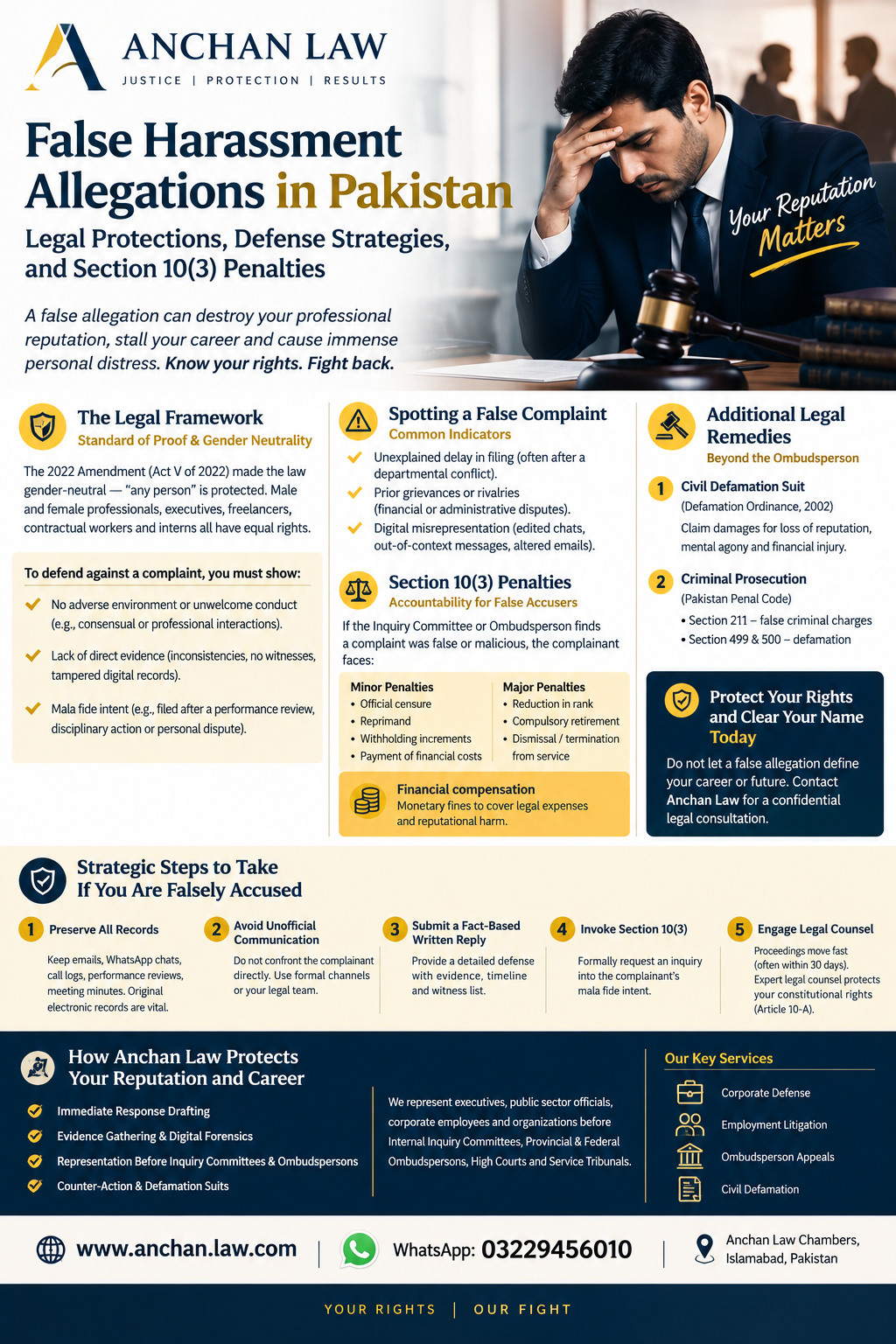
Workplace harassment disputes require careful examination of the statutory definition, evidence, inquiry procedure and rights of both complainant and accused.
The supplied database records PLD 2024 SC 795 concerning the definition of harassment.
The recorded principle states that the definition has been expanded to include conduct that is intimidatory in nature and is not restricted merely to sexual conduct.
Anchan Law can assist with legal representation, legal notices, responses, employment disputes and proceedings concerning workplace harassment, subject to the applicable forum and statutory procedure.
Rent and Eviction Disputes
The supplied database contains rent-law authority including 1999 MLD 3178 Karachi, concerning eviction for bona fide personal requirement where the landlord’s children required the premises for school-related circumstances.
Rent litigation should be assessed under the applicable provincial or territorial rent legislation, because jurisdiction and statutory requirements may vary.
Why Jurisdiction, Limitation and Maintainability Matter
A litigant often focuses exclusively on the merits of the dispute.
A professional litigation assessment should begin earlier.
Before filing a case, the following questions should be considered:
1. Which court has jurisdiction?
2. Is there a specialized tribunal or statutory forum?
3. Is there an alternative remedy?
4. Is the claim within limitation?
5. Is there delay or laches?
6. Is the relief maintainable in constitutional jurisdiction?
7. Does the pleading disclose a cause of action?
8. Is the claim barred by law?
9. What evidence is legally admissible?
10. What interim relief is available?
11. What is the correct statutory remedy?
12. What is the appropriate appellate or revisional forum?
These preliminary questions can be more important than the volume of evidence eventually produced.
Legal Research and Case-Law-Based Litigation Strategy
Effective litigation is not simply about collecting hundreds of judgments.
The better approach is to identify the controlling legal proposition, locate the strongest binding authority, determine whether the judgment remains good law, distinguish adverse authorities and apply the principle to the facts of the case.
Our research approach can be organized around:
- jurisdiction;
- maintainability;
- limitation;
- constitutional jurisdiction;
- statutory interpretation;
- procedural objections;
- evidentiary objections;
- interim relief;
- final relief;
- appellate remedies;
- service law;
- property law;
- family law;
- arbitration;
- commercial disputes;
- taxation;
- employment law;
- administrative law; and
- criminal proceedings.
Anchan Law provides legal services and litigation support in Pakistan, with particular focus on Islamabad and High Court litigation.
Services may include:
High Court Litigation
- Constitutional petitions
- Writ petitions
- Civil litigation
- Service matters
- Employment disputes
- Administrative law
- Public-law challenges
- Appeals and revisions
Civil and Property Litigation
- Property disputes
- Title disputes
- Possession cases
- Injunctions
- Declaratory suits
- Recovery proceedings
- Inheritance and succession
- CDA and Islamabad property matters
- Contractual disputes
- Commercial litigation
Service and Employment Law
- Promotion disputes
- Seniority disputes
- Supersession
- Deferment
- Departmental proceedings
- Service appeals
- Regularization disputes
- Contractual employment
- Unfair labour practice
- NIRC proceedings
- Workplace harassment matters
Family Law
- Divorce
- Khula
- Maintenance
- Child custody
- Guardianship
- Family appeals
- Execution of family decrees
- Property and inheritance issues
Arbitration and Commercial Disputes
- Arbitration agreements
- Arbitrator appointment
- Arbitration proceedings
- Arbitration award challenges
- Enforcement of awards
- Commercial contracts
- Construction disputes
- FIDIC-related disputes
- International arbitration support
Regulatory and Corporate Matters
- Tax disputes
- SECP matters
- Regulatory litigation
- PPRA disputes
- Customs matters
- Corporate legal advice
- Commercial contracts
- Compliance
Criminal Litigation
- Criminal complaints
- Bail matters
- Pre-arrest bail
- Criminal procedure
- Constitutional criminal petitions
- Legal research and drafting
Looking for a Lawyer in Islamabad or Pakistan?
If you are facing a civil dispute, property dispute, employment dispute, service matter, constitutional issue, family dispute, arbitration proceeding, tax matter, regulatory problem or litigation before the Islamabad High Court, the first step should be a proper legal assessment of jurisdiction, limitation, maintainability, evidence and available remedies.
Anchan Law — Advocates & Corporate Consultants
Islamabad, Pakistan
Legal Consultation | Litigation | High Court Representation | Civil & Commercial Disputes | Service Law | Property Law | Family Law | Arbitration | Corporate & Regulatory Matters
Contact Anchan Law: 03229456010
Frequently Asked Questions — Pakistan Legal Services
Who is the best lawyer for a High Court case in Islamabad?
The appropriate Advocate depends upon the subject matter, forum, complexity and required remedy. A High Court matter should be assessed by an Advocate experienced in the relevant area of litigation.
Can I file a writ petition directly in the Islamabad High Court?
Whether a writ petition is maintainable depends upon constitutional jurisdiction, the nature of the impugned action, availability of an alternative remedy, limitation/laches and the facts of the case.
What is the difference between a civil suit and a constitutional petition?
A civil suit ordinarily involves adjudication under civil law and procedure, including evidence where required. Constitutional jurisdiction is supervisory/public-law jurisdiction subject to constitutional and judicial limitations.
Can a High Court decide disputed questions of fact?
Where determination requires extensive evidence and factual examination, constitutional jurisdiction may not ordinarily be the appropriate forum. The exact facts and statutory framework must be examined.
What is limitation in Pakistani law?
Limitation prescribes the legally applicable period within which particular proceedings must ordinarily be initiated. Different claims and forums can have different limitation periods.
Can delay be condoned?
In appropriate circumstances, the law permits condonation of delay, but the requirements depend upon the relevant statutory provision, facts and applicable case law.
What is Order VII Rule 11 CPC?
Order VII Rule 11 CPC provides grounds upon which a plaint may be rejected at the threshold, including circumstances where the suit is barred by law. The precise application depends upon the pleadings and applicable law.
What are the requirements for a temporary injunction?
The supplied authorities identify prima facie case, balance of convenience and irreparable loss as important requirements for interim injunctive relief.
What is res judicata?
Res judicata is the principle preventing re-litigation of matters that have already been finally determined where the statutory requirements are satisfied.
Can a contractual employee claim regularization?
Contractual employment does not automatically create a vested right to regularization. The supplied database records 2022 PLC (C.S.) 947 for the requirement of statutory support.
Can an arbitration award be challenged?
Yes, but the grounds and procedure depend upon the applicable arbitration law and the circumstances of the award. Courts do not ordinarily function as appellate forums merely to reappraise the merits of an arbitrator’s decision.
Can a court execute an order through contempt?
The supplied authorities distinguish execution proceedings from contempt jurisdiction and record that execution is generally the appropriate mechanism for implementing a decree or order where execution is available.
What is quo warranto?
Quo warranto is a constitutional/public-law remedy concerning the legal authority of a person to hold a public office. The supplied authorities identify specific conditions concerning the nature of the office and legality of the appointment.
What is the welfare principle in child custody cases?
The welfare of the minor is recorded in the supplied authorities as the paramount consideration in determining custody.
Conclusion
Pakistani litigation requires more than identifying a legal grievance. A successful legal strategy may depend upon jurisdiction, limitation, maintainability, statutory interpretation, pleadings, evidence, procedural compliance, interim relief, forum selection and the correct application of binding precedent.
From Islamabad High Court constitutional petitions and service matters to property disputes, civil litigation, family cases, employment disputes, arbitration, taxation and regulatory litigation, each case requires an assessment based upon its specific facts and governing law.
Anchan Law provides legal consultation, drafting, research and representation for individuals, businesses, employees and litigants seeking professional legal assistance in Islamabad and across Pakistan.
Anchan Law — Advocates & Corporate Consultants
Islamabad, Pakistan
Contact us

This article is intended for legal information and general research. It does not constitute legal advice for a particular case. Reported judgments and statutory provisions should be verified against the latest authoritative sources before being relied upon in court.
This version is intentionally keyword-rich without stuffing the same keyword into every paragraph—that is generally stronger for SEO than mechanically repeating “Islamabad lawyer” or “Pakistan lawyer.” It also turns your case-law database into an Anchan Law authority/resource page, rather than making it look like a generic legal blog.