
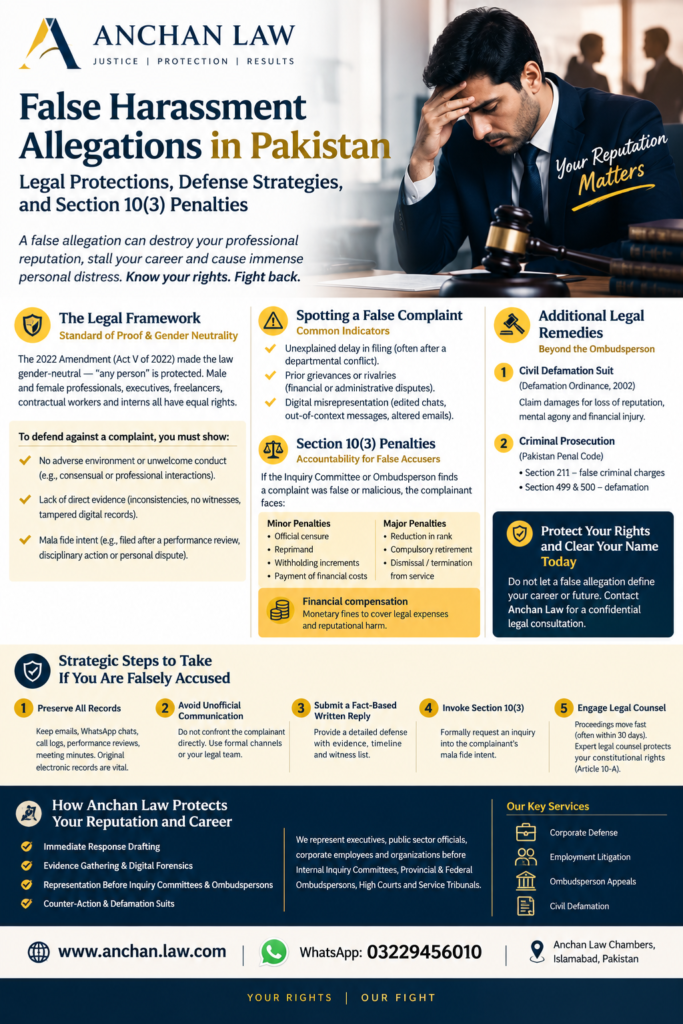
A single false harassment allegations of workplace harassment can destroy decades of hard-earned professional reputation, stall career progression, and cause severe personal distress. While the Protection Against Harassment of Women at the Workplace Act, 2010 (as amended in 2022) provides essential safeguards for legitimate grievances, the law is occasionally weaponized by disgruntled colleagues, subordinate staff, or management rivals to settle personal scores, resist disciplinary actions, or execute corporate blackmail.
If you or your organization are facing a fabricated or malicious workplace harassment allegations understanding your statutory rights, procedural defenses, and legal remedies is critical to clearing your name and holding false accusers accountable.
The Legal Framework: Standard of Proof and Gender Neutrality
The 2022 Amendment (Act V of 2022) fundamentally altered the scope of workplace harassment laws in Pakistan. The statute updated key language from “a woman or man” to “any person”, making the law fully gender-neutral.
Today, male and female professionals, executives, freelancers, contractual workers, and interns share identical statutory protections and face identical exposure to potential false Harassment Allegations.
To successfully defend against a workplace harassment complaint or Harassment Allegations before an Internal Inquiry Committee (IIC) or the Federal/Provincial Ombudsperson (FPOPAH//PPOPAH), the accused must establish that the complaint/harassment allegations fails to meet the legal standards defined under the Act:
- Absence of Adverse Environment or Harassment Allegations: Demonstrating that interactions were consensual, strictly professional, or fabricated.
- Lack of Direct Evidence in Harassment Allegations: Highlighting inconsistencies in oral statements, absence of corroborating witnesses, or tampered digital records.
- Mala Fide (Bad Faith) Intent: Proving the complaint was lodged immediately after an adverse performance appraisal, disciplinary inquiry, or administrative dispute.
Weaponizing the Law: The Scope of False harassment allegations/ Complaints
The High Court and Supreme Court of Pakistan firmly establish that we must maintain workplace safety and that anti-harassment mechanisms o cannot be used for administrative extortion or revenge.
Common indicators of a fabricated complaint include:
- Unexplained Delay: Unreasonable delay in filing the complaint/Harassment Allegations without a plausible explanation, often coinciding with an unrelated departmental conflict.
- Prior Grievances & Rivalries: Clear documentary evidence of an ongoing personal dispute, financial disagreement, or administrative rivalry resulting as a false Harassment Allegations
- Digital Misrepresentation: Excerpted or out-of-context text messages, altered chat logs, or selectively edited emails submitted to mislead inquiry officers.
Statutory Defense: Invoking Section 10(3) Against False Harassment Allegations
Pakistani law does not leave the falsely accused defenseless. Section 10(3) of the Act provides a direct, statutory counter-remedy against individuals who lodge false, fabricated, or malicious complaints.
“If the Inquiry Committee or the Ombudsperson, as the case may be, comes to the conclusion that the complaint /Harassment Allegations was false or made with malicious intent, it may recommend to the Competent Authority or impose upon the complainant any of the minor or major penalties specified in sub-section (4) of section 4.”
When an Inquiry Committee or Ombudsperson finds that a complaint was filed with active malice or ulterior motives, the false accuser of Harassment Allegations faces severe statutory penalties, including:
- Minor Penalties: Official censure, reprimand, withholding of increments, or order to pay financial costs to the exonerated party.
- Major Penalties: Reduction in rank, compulsory retirement, or dismissal/termination from service.
- Financial Compensation: Award of monetary fines payable directly to the respondent to compensate for legal expenses and reputational harm.
Additional Legal Remedies Beyond the Ombudsperson
Once an Inquiry Committee or the Ombudsperson dismisses a false complaint /Harassment Allegations and records a finding under Section 10(3), the exonerated professional can pursue external civil and criminal remedies to restore their standing:
1. Civil Defamation Suit (Defamation Ordinance, 2002)
You can file a suit for damages in the District Court seeking monetary compensation for loss of reputation, mental agony, and financial injury caused by public or workplace allegations.
2. Criminal Prosecution (Pakistan Penal Code)
- Section 211, PPC: Prescribes imprisonment and fines for intentionally instituting false criminal charges or proceedings without lawful grounds.
- Section 499 & 500, PPC: Authorizes criminal prosecution for defamation against individuals who publish or communicate false imputations to injure reputation.
Strategic Steps to Take If You Are Falsely Accused
If you receive a notice from an Internal Inquiry Committee or an Ombudsperson, immediate and structured legal action is vital:
- Preserve All Digital & Physical Records: Do not delete emails, WhatsApp chats, call logs, performance reviews, or meeting minutes. Original electronic records are essential for forensic defense.
- Avoid Direct Unofficial Communication: Do not confront the complainant directly outside formal proceedings. Conduct all communications through formal channels or legal representation.
- Submit a Fact-Based Written Reply: File a comprehensive, point-by-point defense supported by documentary evidence, timeline analysis, and witness lists.
- Invoke Section 10(3) Formally: Explicitly pray for an inquiry into the complainant’s mala fide intent under Section 10(3) within your formal written response.
- Engage Specialized Legal Counsel: Harassment proceedings move rapidly under strict statutory timelines (often 30 days). Having experienced legal counsel ensures your constitutional rights to due process (Article 10-A) are fully protected.
How Anchan Law Protects Your Reputation and Career
At Anchan Law, we specialize in high-stakes employment litigation, civil defense, and corporate compliance, Harassment Allegations. We represent executives, public sector officials, corporate employees, and organizations before Internal Inquiry Committees, Provincial and Federal Ombudspersons, High Courts, and Service Tribunals.
Our complete legal defense package includes:
- Immediate Response Drafting: Formulating structured, fact-based written defenses to quash baseless allegations at the preliminary stage.
- Evidence Gathering & Digital Forensics: Securing and presenting verifiable digital records, chat histories, and documentary proof to establish mala fide intent.
- Representation Before Inquiry Committees & Ombudspersons: Providing skilled legal representation during cross-examinations and oral hearings.
- Counter-Action & Defamation Suits: Initiating formal Section 10(3) proceedings, civil defamation actions, and criminal prosecutions to clear your name completely.
Protect Your Rights and Clear Your Name Today
Do not allow a false harassment allegations to define your career or compromise your future. Contact Anchan Law today to schedule a confidential legal consultation with our legal team.
- Office: Anchan Law Blue Area , Islamabad, Pakistan
- Services: Corporate Defense, Employment Litigation, Ombudsperson Appeals, Civil Defamation
- CONTACT US NOW
also See Our similar Articles