
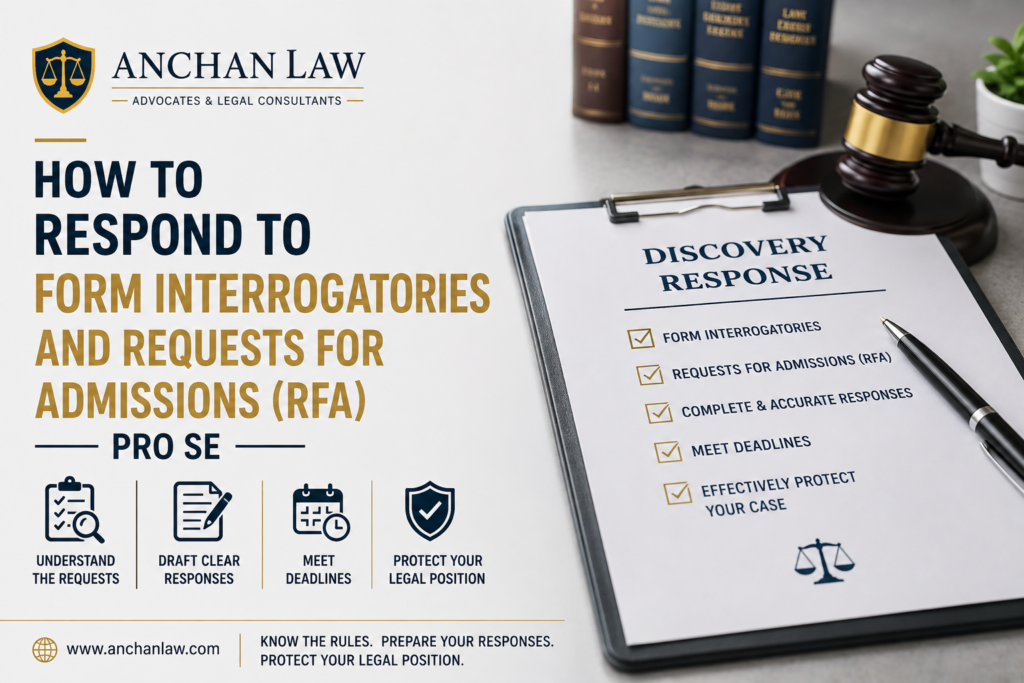
Entering the per-trial discovery phase of a lawsuit is a high-stakes challenge for any self-represented litigant. If you have been served with Form Interrogatories, Special Interrogatories, or Requests for Admissions (RFA), you must act quickly Respond to Form Interrogatories and Requests for Admissions (RFA) Pro Se.
Knowing how to draft legally compliant answers and assert proper discovery objections is essential to protecting your lawsuit. Understanding Interrogatories vs. Requests for Admissions Discovery is the formal legal process where opposing parties must exchange evidence under oath before trial. while responding to Form Interrogatories and Requests for Admissions (RFA) Pro SeThe two most common tools used by corporate defense lawyers are:
Form and Special Interrogatories: Written questions demanding detailed factual answers. Form Interrogatories are standard court-approved questions covering basic information like witness lists, insurance policies, and damages. Special Interrogatories are custom-written questions targeting specific details of your unique claim.Requests for Admissions (RFA):
Written statements that force you to admit or deny specific facts. If you admit a statement, it is deemed true for the rest of the trial, and you cannot dispute it later. The Danger of Missing Your Discovery Deadline In most state and federal courts, you have exactly 30 days (plus a few extra days if the documents were mailed to you) to serve your formal responses. Failing to meet this strict deadline carries severe consequences:
Waiver of Objections: Missing the deadline means you permanently lose your right to object to vague, overly burdensome, or invasive questions
. The RFA “Deemed Admitted” Trap: If you fail to respond to a Request for Admission on time, the defense can ask the judge to deem every statement admitted. If you “admit” that you have no damages or that the incident was your fault, your lawsuit is effectively over.
Monetary Sanctions: Courts can fine pro se litigants or dismiss cases entirely for failing to participate in discovery.
Step-by-Step Guide to o Respond to Form Interrogatories and Requests for Admissions (RFA) Pro Se. Because there are no standard fill-in-the-blank forms for discovery answers, your responses i Response to Form Interrogatories and Requests for Admissions (RFA) Pro Se must be professionally formatted on 28-line pleading paper and structured exactly to court standards:
1. Format the Pleading Properly : Your response document must feature a standard court caption. Directly beneath the case number, you must clearly state the name of the requesting party, the responding party, and the specific set number (e.g., “Plaintiff’s Responses to Defendant’s Form Interrogatories, Set One”).
2. Answer in the Correct Order: You must address every question individually, keeping them in the exact numerical order used by the defense. While you do not have to copy the question text itself, your answer number must match their question number perfectly.
3. Draft Strategic Legal Objections: You do not have to answer questions that violate court rules. If a question is unfair, you must state your objections clearly before providing any answers. Common legal objections include:Overly Broad and Unduly Burdensome: The request demands an unreasonable amount of research or irrelevant information.Attorney-Client Privilege: The question asks for confidential discussions between you and a legal professional.
Vague and Ambiguous: The question is poorly phrased, making it impossible to determine what information is being requested
.4. Verify Under Penalty of Perjury: Interrogatory responses function as testimony under oath. You must sign a Verification Page at the end of your document, declaring under penalty of perjury that your factual answers are true and accurate. Protect Your Civil Rights Case with Expert Drafting Assistance Drafting discovery responses requires precise legal language. One poorly worded answer can give corporate lawyers the leverage they need to file a Motion for Summary Judgment and get your lawsuit thrown out.
At Anchan Law, we specialize in providing Pro Se Litigant Support Services. Our experienced legal professionals help you draft precise discovery responses, identify strategic objections, and avoid defense traps. Ensure your answers are legally sound and filed on time. Contact Anchan Law Today to get professional help with your discovery paperwork