
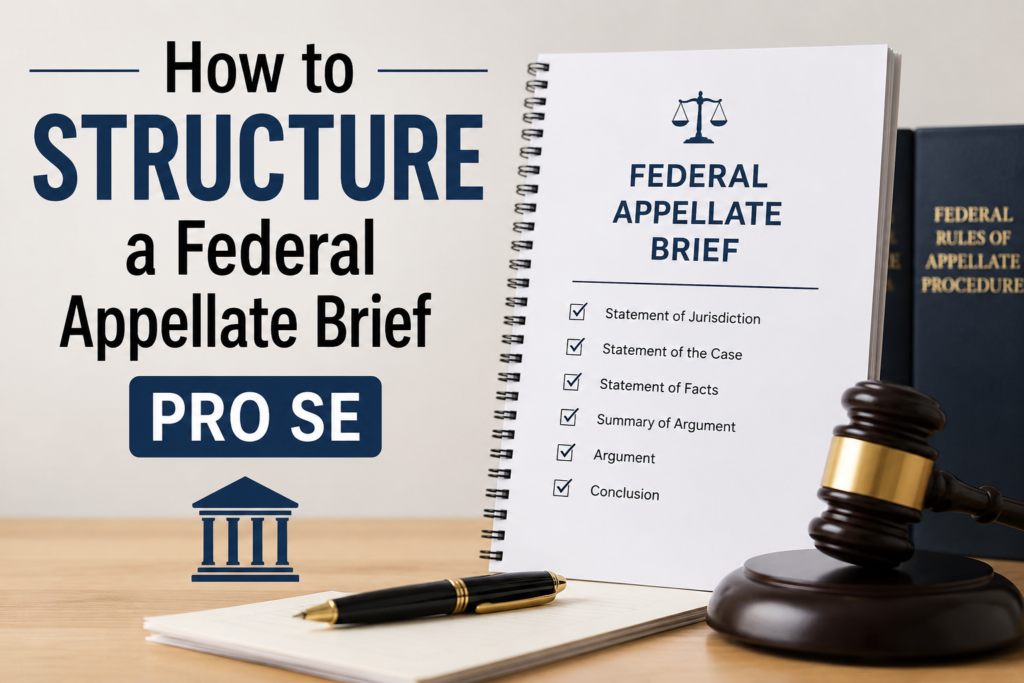
Losing a case in the United States District Court is a devastating blow. However, a final judgment does not mean your pursuit of justice is over. You have the right to challenge the decision by filing an appeal with the United States Court of Appeals. Filing a Federal Appellate Brief as a self-represented (pro se) litigant is one of the most complex procedural undertakings in the American legal system However to Structure a Federal Appellate Brief Prose the guidelines are herein under: .
The rules governing appellate litigation are completely different from trial court rules.Appellate courts do not hear new witness testimony, and they do not look at new evidence. They strictly review the existing district court record to determine if the trial judge made a prejudicial legal error. To get the circuit judges to review your case, your paperwork must strictly follow the Federal Rules of Appellate Procedure (FRAP).
The Deadliest Appellate Mistake: re litigating the FactsThe absolute fastest way to have your federal appeal dismissed is to treat your brief like a second trial. Pro se litigants frequently spend pages complaining about the opposing party or rewriting their original story. The appellate court will ignore this.The Court of Appeals works under a strict standard of review. Your brief must prove that the district court judge committed a specific, reversible error of law, such as:Incorrectly granting a Motion for Summary Judgment.Applying the wrong statutory legal standard to your claims.Abusing their judicial discretion by excluding critical evidence.The Mandatory Structural Elements of a Federal Appellate BriefUnder FRAP Rule 28, a federal opening brief must follow a highly rigid, mandatory structure. If you omit any of these sections, the clerk of the court will reject your brief, and you risk missing your non-negotiable filing deadline.
Your brief must be organized in the following exact order:
- 1. Corporate Disclosure Statement & Table of Contents Even as an individual, you must include a disclosure statement. This is immediately followed by a detailed Table of Contents and a Table of Authorities—an alphabetical list of all federal cases, statutes, and constitutional provisions cited in your text, including the exact page numbers where they appear.
- 2. Jurisdictional StatementYou must explicitly prove to the circuit court that they have the legal authority to hear your appeal. This section must state the statutory basis for the district court’s jurisdiction, the appellate court’s jurisdiction, the exact date the final judgment was entered, and the date you filed your Notice of Appeal.
- 3. Statement of the Issues PresentedThis is a concise, numbered list of the exact legal questions you want the circuit judges to decide.Example: “Whether the District Court erred in granting summary judgment by ignoring material factual disputes regarding the plaintiff’s Title VII retaliation claim.”
- 4. Statement of the Case and FactsThis is a chronological narrative of the litigation history and the relevant facts of the case. Every single factual statement you make must be followed by a precise citation to the official Appendix or Record on Appeal (e.g., “R. at Page 14”). Uncited facts will be entirely disregarded.
- 5. Summary of the ArgumentA punchy, two-to-three-page synopsis of your central legal positions. It should act as a standalone road map that previews your technical arguments
- .6. The Legal Argument SectionThis is the core of your brief. You must break your arguments down using clear headings (e.g., Argument I, Argument II). For each issue, you must state the applicable standard of review (such as de novosibirsk or abuse of discretion) and use binding Supreme Court and Circuit Court precedents to demonstrate exactly how the lower court erred.
- 7. Conclusion and Request for Relief A precise statement telling the court exactly what you want them to do—such as reversing the dismissal order and remanding the case back to the district court for a jury trial.Strict Formatting
- The Certificate of ComplianceFederal appellate courts enforce rigid formatting limits under FRAP Rule 32. Your brief must adhere to specific margins, line spacing, and font styles. Most importantly, opening briefs are strictly capped by word count (typically 13,000 words). You must attach a signed Certificate of Compliance verifying that your document does not exceed these statutory limits.Secure Court-Ready Drafting Support for Your Federal AppealThe procedural barriers in federal circuit courts are intentionally high to filter out non-compliant filings. A single formatting error, a missing citation to the record, or an unstructured legal argument can result in a summary dismissal of your appeal before a judge ever reads your arguments.
Disclaimer: The information and contents of this blog are provided for informational and educational purposes only and should not be construed as formal legal advice on any matter.
Accessing or reading this blog does not create an attorney-client relationship between the reader and Anchan Law. Readers should not act or refrain from acting upon any information contained in this blog without seeking professional legal counsel tailored to their specific circumstances and applicable jurisdiction.