
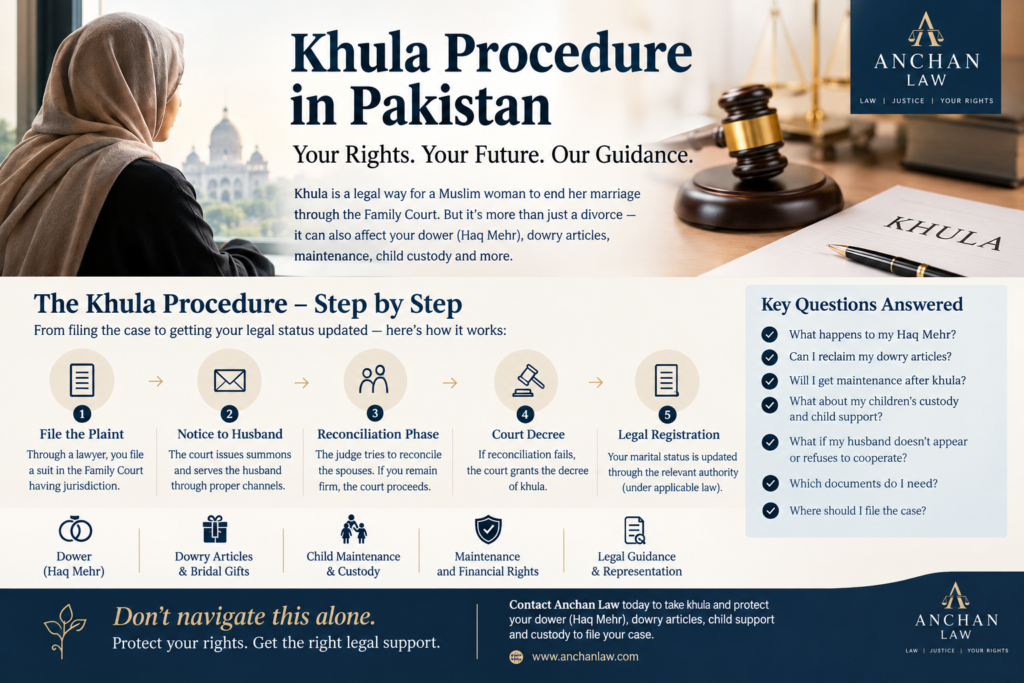
The khula procedure in Pakistan provides a judicial mechanism through which a Muslim woman seeks dissolution of marriage. Proceedings relating to dissolution of marriage fall within the jurisdiction of the Family Courts under the West Pakistan Family Courts Act, 1964, while the legal framework also operates alongside the principles of Muslim personal law and, where applicable, the Dissolution of Muslim Marriages Act, 1939.
Khula is distinct from a dissolution of marriage obtained on statutory grounds such as cruelty, failure to maintain, disappearance of the husband or other grounds recognized under section 2 of the Dissolution of Muslim Marriages Act, 1939.
The distinction is particularly significant because the legal consequences concerning dower (Haq Mehr) can differ according to the basis upon which the marriage is dissolved.
What Is Khula Under Pakistani Law? Khula Procedure in Pakistan :
Khula is a form of dissolution of marriage in which the wife seeks release from the marital relationship.
The Family Courts Act, 1964 provides the procedural framework for Khula Procedure in Pakistan: for suits concerning dissolution of marriage. Section 10 deals with pre-trial proceedings and reconciliation, while subsection (5) contains provisions concerning dissolution on the ground of khula and the treatment of dower.
Khula is therefore a judicial remedy rather than merely an administrative cancellation of a marriage registration.
The legal character of the proceedings becomes particularly important where questions concerning dower, dowry articles, maintenance or children arise alongside the dissolution claim.
Khula and Dissolution Under the Dissolution of Muslim Marriages Act, 1939
Pakistani law recognizes grounds upon which a Muslim woman obtains a decree for dissolution of marriage.
Section 2 of the Dissolution of Muslim Marriages Act, 1939 includes grounds such as:
- failure of the husband to maintain the wife;
- imprisonment;
- failure to perform marital obligations;
- impotence;
- insanity or certain forms of serious illness;
- cruelty; and
- other grounds recognized under Muslim law.
Cruelty under section 2(viii), for example, includes habitual assault or conduct that makes the woman’s life miserable, disposal of her property or obstruction of her legal rights, and other specified forms of conduct.
A case based upon one of these statutory grounds is legally distinguishable from a case in which the wife expressly seeks khula.
The Supreme Court on the Right to Seek Khula
The Supreme Court of Pakistan has emphasized that khula is an exclusive right of the woman.
In a judgment concerning C.P. No. 4657 of 2022 and connected matters, the Supreme Court held that a woman must express her intention to exercise the right of khula in clear and unequivocal terms. The Court further held that a Family Court cannot independently grant khula where the woman has not sought khula herself.
The reasoning is directly connected with the financial consequences associated with khula, particularly the statutory treatment of dower.
The judgment also distinguishes a case of khula from a case where the wife establishes another legal ground for dissolution. Where the dissolution rests upon divorce by the husband or a legally established ground such as cruelty, the Supreme Court recognized the wife’s entitlement to dower in the circumstances before it.
This distinction is fundamental to understanding the khula procedure in Pakistan.
Step 1: Institution of the Khula Suit
The proceedings of Khula Procedure in Pakistan: commence through a suit before the competent Family Court.
The plaint identifies:
- Khula Procedure in Pakistan:
- the marriage;
- the parties;
- relevant matrimonial circumstances;
- the basis of the dissolution claim;
- the relief concerning dissolution; and
- any additional family claims falling within the jurisdiction of the Family Court.
The Family Courts Act provides the statutory framework governing these proceedings.
The jurisdiction of the particular Family Court depends upon the applicable territorial-jurisdiction provisions and the circumstances of the parties.
Step 2: Service of Notice Upon the Husband
Following institution of the proceedings, notice is issued to the defendant husband in accordance with the applicable procedural requirements.
The husband’s response may include:
- appearance before the Family Court;
- filing of a written statement;
- contesting the dissolution;
- contesting financial claims;
- raising questions concerning dower or dowry articles; or
- non-appearance after service.
The Family Court’s subsequent procedure in Khula Procedure in Pakistan: depends upon the pleadings and the procedural circumstances of the case.
Step 3: Reconciliation Proceedings
Reconciliation forms an important part of the statutory Family Court procedure.
Section 10 of the Family Courts Act provides for reconciliation/compromise proceedings in suits for dissolution of marriage. Where reconciliation fails, the proceedings continue according to the statutory framework.
The reconciliation stage does not convert every dissolution case into a khula case.
The Supreme Court has specifically held that the wife’s own unequivocal expression of the right to seek khula remains essential where the decree is based upon khula.
Step 4: Determination of the Dissolution Claim
Where the statutory requirements for dissolution are satisfied and reconciliation has failed, the Family Court determines the dissolution claim in accordance with the applicable legal basis. Khula Procedure in Pakistan:
The distinction between:
(a) khula, and
(b) dissolution on a statutory ground
remains relevant at this stage.
The legal basis of the decree has consequences for the financial rights associated with the marriage.
Haq Mehr and Khula
One of the most important legal questions in a khula case/Khula Procedure in Pakistan concerns Haq Mehr (dower).
It is inaccurate to describe the law simply as a rule that a woman automatically loses all of her dower whenever she obtains khula.
The legal treatment of dower depends upon the statutory framework, the basis of dissolution, the nature of the dower and the circumstances of the case.
Section 10(5) of the Family Courts Act contains specific provisions concerning dower where dissolution is granted on the ground of khula.
The Supreme Court has also emphasized that this financial consequence is one reason why the wife’s consent and express choice of khula are legally significant.
Accordingly, khula, dower and dissolution on fault-based grounds cannot be treated as interchangeable concepts.
Khula Does Not Automatically Mean Surrender of Every Property Right
Dower and dowry are legally distinct concepts.
Haq Mehr arises from the marriage contract.
Dowry articles, bridal gifts and personal belongings involve different legal questions concerning ownership, possession and proof.
Consequently, a khula proceeding does not by itself provide a general rule under which every article associated with the marriage becomes the property of the husband.
The legal characterization of a particular article depends upon the circumstances in which it was provided, its ownership and the evidence available before the court.
Khula and Dowry Articles
Claims concerning dowry articles may arise separately from the question of dissolution.
Relevant evidence can include:
- Nikahnama entries;
- lists of articles;
- receipts;
- photographs;
- correspondence;
- witnesses; and
- other evidence concerning delivery and possession.
The nature and ownership of the articles remain questions for determination under the applicable law and evidence.
The distinction between dower and dowry articles is therefore important when examining the financial consequences of a khula proceeding.
Khula and Child Custody
Dissolution of marriage does not itself determine every question concerning children.
Custody is a separate legal issue governed by the applicable family-law principles and the welfare of the child.
Questions concerning children can include:
- physical custody;
- visitation;
- education;
- medical care;
- residence; and
- financial maintenance.
The Supreme Court has also addressed attempts to make surrender of child custody a condition of a khula arrangement. In C.P. No. 4129 of 2019, the Court held that surrender of custody of a child cannot constitute lawful consideration for obtaining khula.
This demonstrates the legal distinction between the wife’s dissolution of marriage and the independent legal rights concerning minor children.
Child Maintenance After Khula
Child maintenance is legally distinct from the wife’s dower claim.
However, the dissolution of the parents’ marriage does not extinguish the child’s legal entitlement to maintenance.
A family proceeding involving children can therefore raise separate questions concerning:
- monthly maintenance;
- educational expenses;
- medical expenses;
- ordinary living expenses; and
- other requirements of the child.
The determination of maintenance depends upon the applicable law and the circumstances established before the competent court.
Can a Husband Prevent Khula by Refusing Consent?
Nevertheless, the husband has no absolute procedural right to prevent a woman from invoking Family Court jurisdiction.
The Family Courts Act provides a judicial framework for dissolution proceedings, including proceedings involving khula.
At the same time, khula has a specific legal character. The Supreme Court has held that the woman herself must clearly seek khula before a Family Court grants dissolution on that basis.
Thus, two separate propositions require distinction:
The husband’s refusal to consent does not itself dispose of the woman’s access to the Family Court.
The wife’s express choice of khula remains necessary where dissolution is granted specifically on the ground of khula.
What Happens If the Husband Does Not Appear?
Non-appearance by the husband does not eliminate the procedural requirements applicable to the proceedings.
The Family Court applies the relevant rules concerning service, appearance and proceedings in the absence of a party.
The consequences of non-appearance therefore depend upon the procedural record of the particular case.
An ex parte proceeding does not transform every allegation in the plaint into an automatically established fact; the court applies the applicable evidentiary and procedural requirements.
Documents Relevant to a Khula Case
The documents commonly relevant to a khula proceeding include:
Marriage documents
- Nikahnama;
- marriage registration record;
- CNICs;
- available information concerning the husband.
Dower-related documents
- Nikahnama entries concerning Haq Mehr;
- evidence concerning payment;
- documents concerning deferred dower;
- documents concerning property or other assets specified as dower.
Dowry-related evidence
- lists of dowry articles;
- receipts;
- photographs;
- correspondence;
- witness information.
Children
- B-Forms;
- birth certificates;
- school records;
- medical records where relevant;
- information concerning maintenance expenses.
The relevance of individual documents depends upon the particular claims raised in the proceedings.
How Long Does the Khula Procedure Take?
There is no single period that applies uniformly to every khula case.
The duration of proceedings can vary according to:
- service of notice;
- appearance of the parties;
- reconciliation proceedings;
- contested or uncontested status;
- evidence;
- additional claims;
- interlocutory proceedings; and
- the workload of the relevant Family Court.
A legally responsible description of the khula procedure therefore avoids guaranteeing a particular number of days for every case.
Khula and Talaq Are Not the Same Legal Process
Khula and talaq represent different legal mechanisms.
Talaq pronounced by the husband is governed by the statutory framework contained in the Muslim Family Laws Ordinance, 1961, including the notice requirements under section 7.
Khula is a judicial dissolution proceeding before the Family Court.
The distinction is important because the statutory provisions governing a husband’s pronouncement of talaq cannot simply be presented as though they constitute the entire procedure governing judicial khula.
Khula in Pakistan: Important Legal Distinctions
The following distinctions provide a clearer understanding of the law:
| Legal issue | Relevant distinction |
|---|---|
| Khula | Judicial dissolution sought by the wife |
| Talaq | Dissolution through the husband’s pronouncement subject to statutory requirements |
| Statutory dissolution | Dissolution on grounds recognized under applicable law |
| Haq Mehr | Dower arising from the marriage contract |
| Dowry articles | Property-related issue distinct from dower |
| Child maintenance | Independent financial right concerning the child |
| Custody | Separate question governed by child-welfare principles |
| Reconciliation | Statutory stage in Family Court proceedings |
| Jurisdiction | Depends upon applicable territorial-jurisdiction rules |
Conclusion
Additionally, khula procedure in Pakistan operates within the statutory framework of the Family Courts Act, 1964 and Muslim family law.
As a result, the legal analysis does not end with the question of dissolution.
A complete examination of a khula case also encompasses the distinction between khula and other grounds of dissolution, Haq Mehr, dowry articles, child maintenance, custody, visitation and the procedural requirements of the Family Court.
The Supreme Court’s jurisprudence establishes particular importance for the woman’s express choice where dissolution is granted on the ground of khula, particularly because of the associated consequences concerning dower.
The statutory framework and case law therefore require khula proceedings to be examined according to the actual pleadings, documents, matrimonial circumstances and legal basis of dissolution rather than through a generalized formula.
For legal consultation and representation concerning khula, including matters relating to dower (Haq Mehr), dowry articles, child maintenance and custody,
This article is intended as general legal information concerning the khula procedure in Pakistan and does not constitute case-specific legal advice.