
Receiving a thick legal packet from a corporate law firm can feel devastating for a self-represented litigant. You open the envelope and discover a “Motion to Dismiss” filed under Federal Rule of Civil Procedure 12(b)(6), packed with legal terminology claiming your lawsuit is defective, meritless, or legally insufficient. A practical Guide to The Pro Se Shield: How to Survive a Rule 12(b)(6) Motion to Dismiss.
For many Pro Se litigants, this moment feels like the end of the case before it has even begun. In reality, a Rule 12(b)(6) Motion to Dismiss is one of the most common procedural tactics used by defense attorneys at the very beginning of litigation. In federal and state courts across the United States, defendants routinely attempt to terminate lawsuits before discovery even starts.
Understanding how this motion works — and how to properly oppose it — can determine whether your case survives or is dismissed permanently. The Pro Se Shield: How to Survive a Rule 12(b)(6) Motion to Dismiss.
This guide explains the legal standard behind Rule 12(b)(6), the protections available to self-represented litigants, and the procedural strategies necessary to keep your case alive.
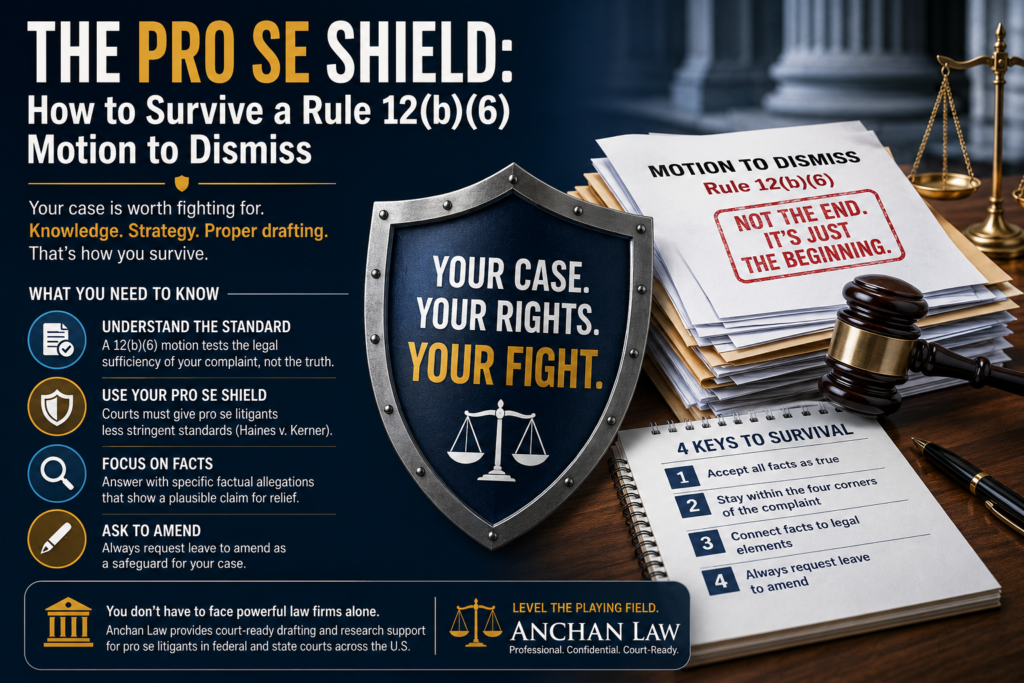
What Is a Rule 12(b)(6) Motion to Dismiss?
A Motion to Dismiss under Rule 12(b)(6) does not argue that you are lying.
Instead, the defendant argues something much more technical:
“Even if every factual allegation in the complaint is assumed to be true, the plaintiff still has not stated a legally valid claim.”
This distinction is critical.
At the 12(b)(6) stage, the court generally does not:
- Weigh evidence
- Decide credibility
- Conduct trials
- Determine who is telling the truth
Instead, the judge reviews only the “Four Corners of the Complaint” — meaning the allegations written within the complaint itself.
The defendant’s goal is straightforward: convince the judge that your complaint fails to state a claim upon which relief can be granted.
If successful, the defense may request dismissal:
- Without Prejudice → You may refile or amend the complaint.
- With Prejudice → Your claims are permanently barred.
For Pro Se litigants, understanding this distinction is essential because an improperly drafted complaint can result in permanent dismissal before discovery even begins.
The Modern Pleading Standard: “Plausibility”
To Survive a Rule 12(b)(6) Motion to Dismiss Federal pleading standards changed dramatically after two landmark United States Supreme Court decisions:
- Bell Atlantic Corp. v. Twombly
- Ashcroft v. Iqbal
Together, these cases established what is now known as the “Plausibility Pleading Standard.”
Under this standard, a complaint must contain enough factual detail to allow the court to reasonably infer that the defendant may be legally liable.
The Supreme Court rejected bare legal conclusions and formulaic accusations.
For example:
Weak Conclusory Allegation
“The defendant discriminated against me.”
This statement alone is usually insufficient.
Plausible Factual Allegation
“On March 4, 2025, my supervisor stated that older employees were too expensive to keep.’ Two days later, my employment was terminated despite positive performance evaluations.”
This second example contains factual context, timing, conduct, and specific allegations that allow the court to infer possible unlawful conduct.
That difference is the heart of modern pleading practice.
Facts vs. “Conclusory Allegations”
Defense attorneys often attack Pro Se complaints by labeling them “conclusory.”
A conclusory allegation is a statement that merely recites legal buzzwords without supporting facts.
The court separates complaints into two categories:
1. Legal Conclusions
Statements the court may ignore:
- “The defendant acted negligently.”
- “The defendant violated my constitutional rights.”
- “The defendant breached the agreement.”
2. Factual Allegations
Statements the court must generally accept as true:
- Dates
- Statements made
- Emails sent
- Meetings conducted
- Actions taken
- Specific conduct by specific individuals
When opposing a Motion to Dismiss, your objective is to show the judge that your complaint contains sufficient factual allegations to state a plausible claim for relief.
The Pro Se Shield: Liberal Construction
Many self-represented litigants are unaware that federal courts recognize a doctrine known as “Liberal Construction.”
This doctrine requires courts to interpret Pro Se pleadings less harshly than documents drafted by licensed attorneys.
Two major Supreme Court cases established this principle:
- Haziness v. Kerner
- Erickson v. Pardus
In Haziness, the Supreme Court stated that Pro Se pleadings are held:
“to less stringent standards than formal pleadings drafted by lawyers.”
This doctrine can be extremely important when the defense attempts to exploit technical drafting imperfections.
Although judges cannot serve as your lawyer, federal courts are generally instructed to focus on the substance of a Pro Se filing rather than dismissing cases solely because of imperfect wording or formatting.
However, liberal construction is not unlimited.
Courts will not rewrite claims for litigants or invent missing facts. The complaint must still contain enough factual material to satisfy the plausibility standard established in Twombly and Iqbal.
Four Critical Rules for Opposing a 12(b)(6) Motion to Survive a Rule 12(b)(6) Motion to Dismiss
1. Remind the Court That Facts Must Be Accepted as True T : How to Survive a Rule 12(b)(6) Motion to Dismiss
Your opposition brief should clearly state the controlling legal standard:
“In reviewing a Rule 12(b)(6) motion, the Court must accept all factual allegations in the Complaint as true and draw all reasonable inferences in favor of the Plaintiff.”
This principle is fundamental.
At this stage, the defense is not allowed to dispute your version of events.
2. Focus on the “Four Corners” of the Complaint
A Rule 12(b)(6) review is generally limited to the complaint itself.
This means the defense should not be introducing outside evidence, witness affidavits, or factual disputes at this stage.
If the defendant attempts to rely heavily on outside evidence, you may argue that:
- The material is improper for a Rule 12(b)(6) review; or
- The motion should be converted into a Motion for Summary Judgment under Rule 56.
Understanding this procedural distinction is extremely important.
3. Connect Specific Facts to Each Legal Element to Survive a Rule 12(b)(6) Motion to Dismiss
One of the most common Pro Se mistakes is telling a compelling story without connecting the facts to the required legal elements.
Your opposition should directly identify:
- What legal claim you asserted
- The required legal elements
- Which paragraphs in your complaint satisfy each element
For example, in a breach of contract claim, you generally must allege:
- Existence of a contract
- Plaintiff’s performance
- Defendant’s breach
- Resulting damages
If your complaint contains factual allegations supporting each element, point the judge directly to those paragraphs.
4. Always Request Leave to Amend to Survive a Rule 12(b)(6) Motion to Dismiss
This may be the single most important procedural protection available to Pro Se litigants.
At the conclusion of your opposition brief, always request permission to amend the complaint if deficiencies exist.
A standard request may read:
“In the alternative, Plaintiff respectfully requests leave to amend pursuant to Federal Rule of Civil Procedure 15(a).”
Federal courts strongly prefer resolving cases on their merits rather than through procedural dismissals.
Requesting leave to amend gives the judge a procedural pathway to allow correction of deficiencies instead of terminating the lawsuit permanently.
Why Many Pro Se Cases Fail
Many self-represented litigants lose viable claims not because the facts are weak, but because the pleadings fail to satisfy technical procedural standards.
Common drafting failures include:
- Missing factual specificity The Pro Se Shield: How to Survive a Rule 12(b)(6) Motion to Dismiss
- Improper structure
- Failure to identify legal elements
- Conclusory allegations
- Inadequate jurisdictional statements
- Poor formatting
- Failure to oppose motions properly
- Failure to request leave to amend
Defense attorneys understand these vulnerabilities and frequently exploit them early in litigation.
Professional Drafting Support for Pro Se Litigants
Opposing a Rule 12(b)(6) Motion to Dismiss requires more than simply explaining your side of the story. It requires technical legal drafting, procedural precision, persuasive organization, and application of binding case law.
Many Pro Se litigants find themselves facing experienced litigation firms with extensive resources and aggressive motion practice.
You do not have to navigate that process alone.
At Anchan Law, we provide professional legal research and court-ready drafting support for self-represented litigants throughout the United States to Survive a Rule 12(b)(6) Motion to Dismiss. Our services include:
- Oppositions to Motions to Dismiss
- Federal and state court pleadings
- Civil rights complaints
- Breach of contract claims
- Discovery motions
- Appellate briefs
- Procedural research and litigation support : How to Survive a Rule 12(b)(6) Motion to Dismiss
We assist Pro Se litigants by analyzing defense motions, identifying procedural weaknesses, applying relevant federal and state authorities, and drafting polished legal documents designed to protect your case and preserve your right to be heard. When strict court deadlines are approaching, professional drafting support can make the difference between dismissal and survival.