Pleadings, Motions, Discovery, Evidence
A Comprehensive Academic Guide to Self-Represented US Prose Civil Litigation in the United States

Introduction
The American civil justice system permits individuals to appear in court without retaining an attorney. Such a litigant is commonly described as appearing pro se or pro per, depending on the jurisdiction and context. Self-representation/ U.S. Pro Se Litigation however, does not eliminate the procedural, evidentiary, jurisdictional, and substantive requirements that govern litigation.
The difficulty of U.S. Pro Se Litigation therefore does not arise simply from the absence of a lawyer. It arises from the need to perform several different legal functions simultaneously: identifying the proper court, establishing jurisdiction, formulating legally cognizable claims or defenses, preparing pleadings, responding to motions, conducting discovery, presenting evidence, complying with procedural deadlines, and, where necessary, pursuing appellate review.
The United States also does not have one unified civil procedure applicable to every civil action. Federal district courts generally operate under the Federal Rules of Civil Procedure, federal statutes, federal appellate rules, local rules, standing orders, and applicable judicial precedent. State courts operate under their respective state constitutions, statutes, rules of civil procedure, local rules, and judicial decisions. U.S. Pro Se Litigation
Consequently, a document or procedure appropriate in one court may not be appropriate in another.
This article examines the principal stages of U.S. pro se civil litigation, with particular attention to pleadings, motions, discovery, summary judgment, civil-rights claims, employment disputes, property and contractual litigation, appeals, and the use of legal research or document-preparation assistance.
It also considers an important boundary: assistance provided to a self-represented litigant is not automatically permissible merely because the litigant remains formally self-represented. The law governing unauthorized practice of law varies by jurisdiction, and the substantive nature of the assistance remains relevant.
1. Understanding Pro Se Litigation
1.1 Meaning of pro se
A person appearing pro se generally acts on their own behalf rather than through an attorney.
The person may be:
- a plaintiff commencing an action;
- a defendant responding to a complaint;
- a counter claimant;
- a respondent to a motion;
- a party conducting discovery;
- a litigant at trial; or
- an appellant or appellee in an appeal. U.S. Pro Se Litigation
The procedural position of the litigant does not change merely because the person is self-represented. The person remains responsible for complying with the rules applicable to the proceeding.
The precise treatment of pro se litigants can vary by court and jurisdiction. Courts may take account of the fact that a party is not represented by counsel in applying certain procedural principles, but self-representation does not ordinarily create a general exemption from procedural rules.
1.2 Pro se status and substantive law U.S. Pro Se Litigation
Self-representation does not create a separate body of substantive law.
A pro se plaintiff bringing a contract claim must still establish the elements applicable to the relevant contract law. A plaintiff asserting a constitutional claim must satisfy the requirements of the applicable federal cause of action. A defendant asserting a procedural defense must identify the rule or legal doctrine supporting that defense.
The distinction between procedural accommodation and substantive entitlement is therefore important.
A court may explain a procedural requirement or construe a filing in a manner permitted by law without creating a substantive claim that otherwise does not exist.
2. Federal and State Court Systems
2.1 Federal civil litigation
The Federal Rules of Civil Procedure govern civil proceedings in United States district courts.
They address subjects including:
- commencement of actions;
- service of process;
- pleadings;
- motions;
- disclosures;
- discovery;
- summary judgment;
- trial;
- judgments;
- post-judgment proceedings; and
- various procedural matters.
Federal Rule of Civil Procedure 1 describes the purpose of the Rules as securing the just, speedy, and inexpensive determination of actions and proceedings.
Federal Rule 8 establishes general pleading requirements. Among other matters, a pleading stating a claim for relief must contain a short and plain statement of the grounds for jurisdiction, a short and plain statement showing entitlement to relief, and a demand for the relief sought. U.S. Pro Se Litigation
Federal Rule 11 addresses representations made to the court and imposes obligations concerning pleadings, motions, and other papers.
These rules form part of a larger procedural system that includes federal statutes, appellate decisions, local district-court rules, standing orders, and individual judicial practices.
2.2 State civil litigation
State civil procedure is not simply a state version of the Federal Rules.
Each state maintains its own procedural system. Terminology, jurisdictional thresholds, pleading standards, filing procedures, discovery requirements, service requirements, motion practice, appellate procedures, and local requirements can differ.
For example, state-specific pro se resources may address distinct procedures in New Jersey, Wisconsin, Alaska, Texas, Louisiana, Ohio, Nebraska, Missouri, North Carolina, New Mexico, Hawaii, and other jurisdictions.
A general statement concerning “U.S. court procedure” therefore requires qualification whenever the issue is controlled by state law.
2.3 Local rules U.S. Pro Se Litigation
Federal and state procedural rules may be supplemented by local rules.
A district court can maintain requirements concerning:
- page limits;
- fonts;
- formatting;
- electronic filing;
- proposed orders;
- motion practice;
- certificates;
- scheduling;
- exhibits;
- redaction’s;
- confidential information; and
- procedures for particular types of cases.
The same principle applies to state trial courts and appellate courts.
A litigant therefore needs to distinguish between:
- substantive law;
- statewide procedural rules;
- federal procedural rules, where applicable;
- local rules;
- standing orders; and
- case-specific orders issued by the judge.
3. Commencing a Civil Action
3.1 The complaint
A civil action ordinarily begins with a pleading or other initiating document prescribed by the applicable jurisdiction.
In federal district court, Rule 8 requires a claim for relief to contain a short and plain statement of the grounds for jurisdiction, a short and plain statement of the claim showing entitlement to relief, and a demand for the relief sought.
The complaint therefore serves several functions. U.S. Pro Se Litigation
It identifies:
- the parties;
- the basis for jurisdiction;
- the factual allegations;
- the legal claims being asserted;
- the relationship between the facts and claims; and
- the relief requested.
A complaint is not merely a narrative account of an event.
A factual event may be important but legally insufficient if the pleading does not connect the relevant facts to a legally recognized claim.
3.2 Jurisdiction
Jurisdiction is one of the foundational questions in civil litigation.
Federal subject-matter jurisdiction can arise through different statutory bases, including federal-question jurisdiction and diversity jurisdiction, subject to the requirements imposed by federal law.
Personal jurisdiction presents a separate question.
Venue is another distinct inquiry.
These concepts should not be treated as interchangeable:
- Subject-matter jurisdiction concerns the court’s authority over the type of dispute.
- Personal jurisdiction concerns the court’s authority over the relevant defendant or party.
- Venue concerns the legally proper geographic forum for the proceeding.
A complaint can therefore present a substantial factual dispute while still encountering an independent jurisdictional or venue problem.
3.3 Parties and defendants
The selection and identification of parties is another significant pleading issue.
A plaintiff may need to identify the person or entity legally responsible for the alleged conduct. In civil-rights litigation, for example, the identity of the actor, the capacity in which the person is sued, state action, personal participation, causation, and applicable immunities can become important.U.S. Pro Se Litigation
Naming every person involved in an underlying event does not automatically make each person a proper defendant.
3.4 Claims and factual allegationsU.S. Pro Se Litigation
A well-organized pleading distinguishes factual allegations from legal conclusions.
Facts describe events.
Legal claims explain why those events allegedly violate a legal obligation.
The relationship between the two is central to pleading practice.
A complaint that describes a dispute extensively but does not connect its factual allegations to the elements of a legally recognized cause of action may face a motion challenging its sufficiency.
4. Answers and Responsive Pleadings
A defendant’s response to a complaint may involve an answer, a motion, or another procedural response depending upon the applicable rules and circumstances.
An answer generally responds to the allegations in the complaint and identifies defenses.
Under federal procedure, Rule 8 addresses admissions, denials, and defenses.
A response should therefore be distinguished from a general narrative.
The relevant questions include:
- Which allegations are admitted?
- Which are denied?
- Which allegations cannot presently be admitted or denied?
- What affirmative defenses are applicable?
- Are there jurisdictional objections?
- Are there procedural defenses?
- Are counterclaims or crossclaims being asserted?
- Does another rule govern the response?
Timing is equally important.
Federal Rule 12 establishes rules concerning certain responsive pleadings and motions. The applicable period may change depending on service, waiver of service, the nature of the filing, and other circumstances.
State rules may establish materially different periods.
5. Amended Complaints and Amended Pleadings
Amendment of pleadings is an important part of civil litigation.
An amended complaint may be used to:
- correct factual allegations;
- add or remove claims;
- address deficiencies identified by a court;
- respond to a motion to dismiss;
- correct party information;
- incorporate additional facts; or
- otherwise modify the pleading where permitted.
The availability of amendment depends on the applicable procedural rules, the procedural posture of the case, prior amendments, court orders, and other circumstances.U.S. Pro Se Litigation
A litigant should therefore distinguish between the conceptual ability to amend a pleading and the procedural right to file an amendment at a particular stage.
An amended complaint also needs to be internally coherent.
When an amendment replaces an earlier pleading, the revised pleading generally needs to present the operative claims and factual allegations in a form that allows the opposing party and court to understand what is presently being asserted.
6. Motions to Dismiss U.S. Pro Se Litigation
6.1 Rule 12(b)(6)
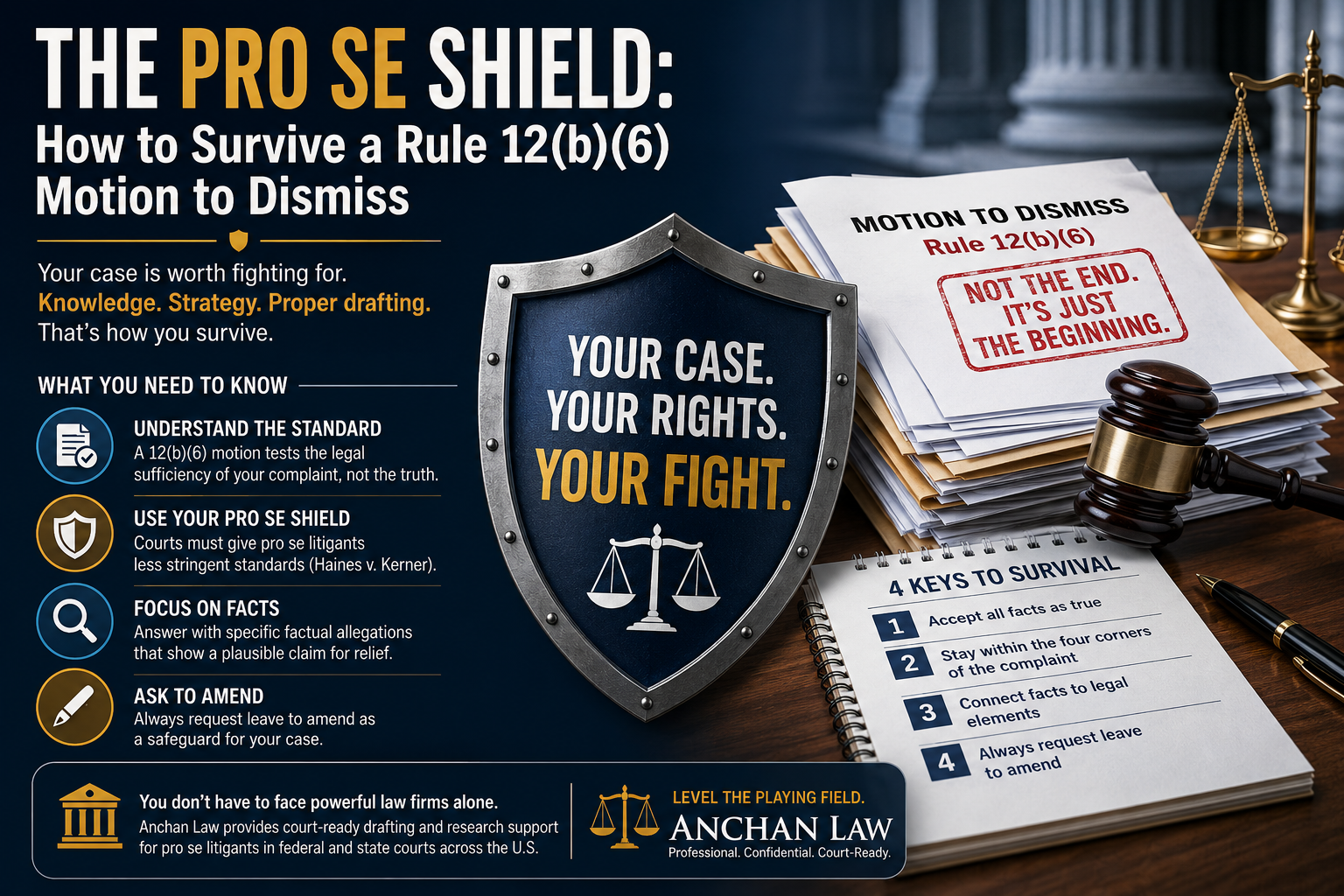
A motion under Federal Rule of Civil Procedure 12(b)(6) challenges whether a complaint states a claim upon which relief can be granted.
The inquiry at this stage is materially different from a trial.
The court is not ordinarily conducting a full evidentiary determination of which witness is truthful. The central question is whether the pleading contains sufficient allegations, accepted under the applicable standard, to state a legally cognizable claim.
The distinction between factual allegations and legal conclusions is therefore significant.
6.2 Pleading standards
A complaint must contain more than labels or conclusions where the applicable pleading standard requires factual allegations sufficient to make the asserted claim legally plausible.
The exact application of pleading doctrine depends upon the governing precedent and the nature of the claim.
The plaintiff therefore needs to identify the legal elements relevant to the claim and determine whether the factual allegations address those elements.
6.3 Opposing a motion to dismiss
An opposition to a motion to dismiss ordinarily addresses the arguments actually presented by the defendant.
An organized response may examine:
- the legal standard;
- the allegations in the complaint;
- the elements of the relevant claim;
- the authorities cited by the defendant;
- the factual allegations supporting each element;
- jurisdictional issues;
- pleading deficiencies alleged by the defendant;
- amendment where legally available; and
- the relief requested.
A response is therefore different from simply repeating the factual story contained in the complaint.
The purpose is to explain why the legal arguments advanced in the motion do or do not justify dismissal under the applicable standard.
6.4 Outside materials
A recurring issue in motion-to-dismiss practice concerns material outside the pleadings.
The treatment of such material depends on the governing procedural rules and applicable judicial doctrine.
A litigant should not assume that every document attached to a motion is automatically treated as trial evidence or that every outside document is automatically disregarded. U.S. Pro Se Litigation
The applicable rule, incorporation principles, judicially noticeable material, and possible conversion to another procedural mechanism may become relevant.
7. Discovery in Civil Litigation
Discovery is the process through which parties obtain information relevant to the claims and defenses in litigation.
Federal discovery is principally governed by Rules 26 through 37 of the Federal Rules of Civil Procedure, subject to proportionality, privilege, court orders, and other limitations.
Common discovery mechanisms include:
- interrogatories;
- requests for production;
- requests for admission;
- depositions;
- subpoenas;
- disclosures; and
- inspection or production of electronically stored information.
7.1 Interrogatories
Interrogatories are written questions directed to another party.
Their permissible scope and numerical limitations depend upon the governing rules and circumstances.
Effective discovery requires more than asking a large number of questions.
The questions should be connected to the issues in dispute and formulated in a manner that allows the responding party to understand what information is sought.
7.2 Requests for production
Requests for production seek documents, electronically stored information, or other materials within the applicable scope of discovery.
A production request may concern:
- contracts;
- correspondence;
- photographs;
- emails;
- records;
- reports;
- financial information;
- electronically stored information; or
- other materials relevant to the dispute.
Privacy, privilege, proportionality, confidentiality, and relevance may affect the appropriate response.
7.3 Requests for admission
Requests for admission seek admissions concerning facts, application of law to fact, or authenticity of documents where permitted by the governing rules.
Their function differs from interrogatories and document requests.
An admission may narrow the factual issues requiring proof at later stages of litigation.
7.4 Discovery responses
Discovery responses can present substantial procedural consequences.
A party may need to:
- answer;
- object;
- produce documents;
- identify withheld material where required;
- preserve relevant evidence;
- supplement responses where applicable; and
- comply with court orders.
Discovery disputes can result in motions to compel, protective orders, sanctions, or other judicial intervention.
8. Evidence and Document Organization
A litigant may possess hundreds or thousands of pages of records.
The existence of a document does not automatically establish its admissibility, relevance, authenticity, or evidentiary weight.
A systematic evidence structure can nevertheless assist in understanding the case.
A litigation record can be organized into:
- chronological documents;
- contracts;
- correspondence;
- notices;
- photographs;
- medical or employment records where relevant;
- court orders;
- pleadings;
- discovery;
- witness materials;
- financial records; and
- other exhibits.
An exhibit index can identify:
| Exhibit | Description | Date | Relevance |
| A | Contract | Date | Establishes contractual relationship |
| B | Written notice | Date | Demonstrates notice |
| C | Correspondence | Date | Documents communications |
| D | Court order | Date | Establishes procedural history |
The index itself does not establish the evidentiary value of the document.
Authentication, hearsay, privilege, relevance, foundation, and other evidentiary doctrines may remain applicable.
9. Summary Judgment
Summary judgment differs fundamentally from a motion to dismiss.
A motion to dismiss generally tests the legal sufficiency of the pleading.
Summary judgment addresses whether the evidence and record establish a genuine dispute concerning material facts and whether a party is entitled to judgment as a matter of law under the governing standard.
Federal Rule 56 governs summary judgment in federal district court.
9.1 Material facts
A fact is significant to the extent that it matters to the legal determination at issue.
A factual dispute is not necessarily sufficient to defeat summary judgment merely because two parties disagree about something.
The dispute must concern a fact that is material under the governing substantive law.
9.2 Evidence
Summary judgment practice therefore requires attention to the evidentiary record.
Depending on the case, relevant materials can include:
- declarations;
- deposition testimony;
- admissions;
- discovery responses;
- business records;
- contracts;
- correspondence;
- photographs;
- electronically stored information; and
- other materials permitted under the applicable rules.
9.3 Statement of facts
A useful summary-judgment presentation normally separates factual assertions from legal argument.
Each material factual proposition should be traceable to supporting evidence.
This allows the court to distinguish:
- what a party alleges;
- what evidence supports the allegation;
- what facts are genuinely disputed; and
- what legal consequences follow from those facts.
10. Civil Rights Litigation Under 42 U.S.C. § 1983
Section 1983 litigation occupies an important area of federal civil-rights litigation.
The statute provides a federal cause of action in specified circumstances involving deprivation of rights secured by the Constitution or federal law by a person acting under color of state law.
A § 1983 case therefore requires attention to several distinct legal questions.
These may include:
- whether the defendant acted under color of state law;
- what constitutional or federal right is alleged to have been violated;
- whether the defendant personally participated in the conduct;
- whether causation is adequately established;
- whether an immunity doctrine applies;
- whether the claim is timely;
- whether the plaintiff has standing;
- what relief is legally available; and
- whether other procedural barriers apply.
The factual narrative is important, but a constitutional allegation is not automatically a § 1983 claim.
The legal theory must correspond to the facts and to the requirements established by statute and precedent.
11. Employment and Discrimination Litigation
Employment litigation may involve overlapping federal statutes, state law, administrative procedures, contracts, workplace policies, and common-law principles.
Potential issues include:
- discrimination;
- retaliation;
- wrongful termination;
- wage disputes;
- contractual claims;
- administrative exhaustion;
- employment classification;
- workplace policies; and
- damages.
Where an administrative agency process is required, the litigant needs to understand the relationship between administrative proceedings and subsequent judicial proceedings.
The existence of an employment dispute does not itself establish a federal cause of action.
The applicable statute, protected characteristic or activity, adverse action, causation, procedural prerequisites, and limitation periods require separate analysis.
12. Property, Contract, Eviction and Foreclosure Litigation
Civil disputes concerning property and contracts constitute a substantial category of state-court litigation.
12.1 Contract disputes
A contract claim commonly requires examination of:
- formation;
- contractual terms;
- performance;
- breach;
- causation;
- damages;
- defenses; and
- available remedies.
The governing law depends upon the nature of the contract and the relevant jurisdiction.
12.2 Property disputes
Property litigation can involve:
- ownership;
- possession;
- boundary disputes;
- title;
- liens;
- easements;
- leases;
- adverse possession;
- foreclosure; and
- related contractual claims.
The procedural route depends substantially on state law.
12.3 Eviction
Eviction proceedings often operate under specialized statutory procedures.
They may involve short response periods, mandatory forms, service requirements, and expedited hearings.
A general federal civil procedure guide cannot safely be substituted for the applicable state or local eviction rules.
12.4 Foreclosure
Foreclosure procedure likewise varies considerably among jurisdictions.
Some states use judicial foreclosure procedures, while others permit nonjudicial procedures subject to statutory requirements.
A litigant therefore needs jurisdiction-specific information concerning notices, deadlines, redemption rights, defenses, mediation requirements, and available judicial remedies.
13. Federal Appellate Litigation
An appeal is not ordinarily a second trial.
The appellate court generally examines the lower court’s decision under the applicable standard of review and within the boundaries established by the appellate rules and record.
Federal appellate practice is governed by the Federal Rules of Appellate Procedure together with circuit-specific rules and orders.
13.1 The appellate record
The record is fundamental.
A party preparing an appellate argument needs to identify where the relevant facts and rulings appear in the record.
A statement unsupported by the record may create a serious problem even where the underlying assertion is factually accurate.
13.2 Standards of review
Different issues receive different standards of appellate review.
Examples include:
- deg novo review;
- abuse of discretion;
- clear error; and
- substantial-evidence or other jurisdiction-specific standards.
The standard of review can materially affect how an appellate argument is structured.
13.3 Appellate brief
An appellate brief generally requires a structured presentation of:
- jurisdiction;
- issues presented;
- procedural history;
- statement of facts;
- legal argument;
- standard of review;
- conclusion; and
- required certificates or appendices.
The exact requirements differ by court.
Word limits, formatting, record citations, certificates, appendix requirements, electronic filing, and deadlines must be checked against the applicable appellate rules.
14. Post-Judgment Proceedings
The conclusion of a trial-level proceeding does not necessarily end the litigation.
Depending on the jurisdiction, post-judgment mechanisms may include:
- motions for reconsideration;
- motions to alter or amend judgment;
- motions for relief from judgment;
- enforcement proceedings;
- objections;
- appeals; and
- other statutory or rule-based remedies.
Each remedy has its own legal basis and timing requirements.
A litigant should therefore identify the source of authority for a proposed post-judgment filing rather than simply describing a filing as a “motion to reopen” or “motion for reconsideration.”
15. Deadlines and Procedural Compliance
One of the most consequential aspects of pro se litigation is procedural timing.
Deadlines can arise from:
- statutes;
- procedural rules;
- court orders;
- scheduling orders;
- service;
- filing;
- appellate rules;
- administrative procedures; and
- local rules.
The method for calculating a deadline can also be governed by the applicable procedural rule.
A litigant should maintain a litigation calendar containing:
| Event | Date | Rule/Order | Deadline | Action Required |
| Complaint served | — | Rule/order | — | Response |
| Motion filed | — | Applicable rule | — | Opposition |
| Discovery served | — | Rule/order | — | Response |
| Scheduling order | — | Court order | — | Compliance |
| Judgment entered | — | Rule | — | Post-judgment review / appeal |
A deadline should never be calculated solely from a general internet article when the governing court rule or order is available.
16. Electronic Filing and Court Documents
Modern litigation frequently involves electronic filing.
Electronic filing systems differ among federal districts, state courts, and appellate courts.
A litigant may encounter requirements concerning:
- registration;
- account creation;
- document format;
- PDF requirements;
- signatures;
- exhibits;
- redaction;
- confidential information;
- payment of filing fees;
- service;
- electronic notices; and
- filing confirmation.
The ability to upload a PDF does not necessarily establish that the filing is procedurally complete.
The document may still need appropriate signatures, exhibits, certificates, fees, or other requirements.
17. Confidential and Sensitive Information
Court filings can contain highly sensitive information.
Federal Rule 5.2 addresses privacy protection for filings in federal proceedings, while state systems may establish separate protected-information rules.
Examples of information that may require particular attention include:
- Social Security numbers;
- financial account numbers;
- dates of birth;
- information concerning minors;
- medical information;
- confidential business information; and
- other protected material.
A litigant should examine the applicable court rule before filing sensitive information publicly.
Privacy protection is not merely a formatting issue. Improper disclosure may create consequences that cannot easily be reversed once information enters the public record.
18. Legal Research for Self-Represented Litigants
Legal research is a process rather than a search for a single favorable case.
A systematic research method generally begins with identifying the legal question.
For example:
Factual issue:
A government employee allegedly suffered an adverse action.
Potential legal issue:
Whether the conduct implicates a constitutionally protected right.
Jurisdictional issue:
Whether the claim arises under federal or state law.
Procedural issue:
Whether the claim is properly pleaded and timely.
Authority:
Statute, constitutional provision, procedural rule, and controlling precedent.
Application:
Whether the identified facts satisfy the legal requirements.
This structure helps prevent a common research problem: collecting authorities without determining what legal proposition each authority actually establishes.
19. Primary and Secondary Legal Authorities
Legal research should distinguish primary authority from secondary commentary.
Primary authority can include:
- constitutions;
- statutes;
- regulations;
- procedural rules;
- court opinions;
- court orders where legally relevant; and
- other authoritative legal materials.
Secondary sources can include:
- treatises;
- law reviews;
- practice guides;
- legal encyclopedias;
- academic commentary; and
- explanatory articles.
A secondary source may help identify an issue, but it does not necessarily establish the governing rule.
For litigation, the researcher should ordinarily trace an important proposition back to the relevant primary authority.
20. Common Problems in Pro Se Litigation
Several recurring problems appear across different types of civil litigation.
20.1 Confusing factual unfairness with a legal claim
A person may have experienced conduct that appears unfair but does not necessarily create a legally actionable claim.
The question is not only what happened.
The question is what legal right or obligation applies to what happened.
20.2 Excessive factual narrative
A lengthy factual narrative can obscure the legal issues.
The objective is not to eliminate relevant facts but to organize them around the elements of the claims and defenses.
20.3 Failure to identify jurisdiction
A complaint may describe the dispute without explaining the legal basis for the court’s jurisdiction.
Jurisdiction should be treated as a foundational issue rather than an afterthought.
20.4 Reliance on unrelated cases
A case may contain similar language but arise under materially different facts, statutes, procedural postures, or jurisdictions.
The relevance of precedent depends upon its actual holding and legal context.
20.5 Failure to connect evidence to factual propositions
A large exhibit file does not automatically establish a factual proposition.
The litigant needs to identify what each piece of evidence is intended to establish and whether it is legally usable for that purpose.
20.6 Ignoring local rules
A filing that satisfies a federal rule may still encounter a local-rule problem.
Local rules should therefore be checked before filing.
20.7 Treating every procedural problem as constitutional
Not every procedural error constitutes a constitutional violation.
Constitutional claims require analysis under the relevant constitutional provision and governing doctrine.
21. The Difference Between Information, Research, Drafting and Representation
The boundaries surrounding legal assistance deserve particular attention when the person providing assistance is not admitted to practice in the relevant U.S. jurisdiction.
Legal information generally describes the law at a general level.
Legal research involves locating and analyzing legal authorities.
Document preparation concerns the creation, organization, or formatting of documents.
Legal advice involves applying law to a person’s particular circumstances and recommending a course of legal action.
Representation involves acting for a person in a legal proceeding or legal relationship.
These categories can overlap in practice.
The legal classification of an activity is therefore not determined solely by the label attached to it.
22. Unauthorized Practice of Law and Non-U.S. Legal Professionals
Unauthorized practice of law is governed primarily by the law of the relevant jurisdiction.
The American Bar Association’s Model Rule 5.5 recognizes the principle that a lawyer must not practise law in a jurisdiction in violation of that jurisdiction’s regulation of the legal profession or assist another in doing so. The accompanying commentary expressly recognizes that the definition of the practice of law varies from jurisdiction to jurisdiction.
The Model Rules are not themselves a uniform national statute. They provide a professional framework that individual jurisdictions may adopt, modify, or replace.
This distinction is particularly important for a foreign-qualified lawyer.
A person may be fully qualified to practise law in one country while lacking authority to practise U.S. law in a particular state.
Foreign legal qualification therefore should not be presented as equivalent to admission to a U.S. bar.
Nor does the physical location of the service provider necessarily answer every UPL question. The nature of the service, the jurisdiction involved, where the legal activity is directed, and applicable law may all be relevant.
23. Why a Disclaimer Alone Is Not Sufficient
A disclaimer can accurately identify the provider’s professional status and define the intended scope of a service.
A disclaimer cannot, however, transform an otherwise prohibited activity into a permitted activity.
For example, describing a service as:
- “scrivener service”;
- “legal research”;
- “document preparation”;
- “pro se support”; or
- “non-attorney assistance”
does not by itself determine whether the underlying conduct is permitted.
The substantive nature of the activity remains relevant.
Accordingly, a responsible non-U.S. legal-support model requires more than a disclaimer. It requires screening of the jurisdiction, definition of the service, identification of excluded activities, careful advertising, appropriate handling of client information, and referral to licensed U.S. counsel where the requested activity requires a U.S. attorney.
24. Scope Limitations for Non-U.S.-Licensed Assistance
Where assistance is legally available, a clear separation between the self-represented litigant and the service provider is important.
The self-represented litigant remains responsible for:
- the truthfulness of factual allegations;
- verification of authorities;
- litigation decisions;
- filing;
- service;
- communications with the court;
- compliance with court orders;
- deadlines; and
- the decision whether to seek representation.
The existence of assistance with organization or preparation does not transfer these responsibilities to an unlicensed service provider.
Where the law requires licensed representation or legal advice, the appropriate course is consultation with an attorney admitted in the relevant jurisdiction.
25. Academic and Practical Significance of Pro Se Litigation
Pro se litigation illustrates a broader tension within civil justice systems.
Courts require procedural rules to maintain orderly proceedings, protect opposing parties, manage judicial resources, and provide consistent adjudication.
At the same time, individuals may face litigation without the resources or circumstances necessary to retain counsel.
The result is a procedural environment in which accessibility and procedural regularity operate simultaneously.
The existence of procedural rules therefore does not make self-representation impossible. It makes procedural literacy important.
Understanding the difference between jurisdiction and venue, pleading and proof, a motion to dismiss and summary judgment, discovery and evidence, trial and appeal, and substantive law and procedure can materially improve a litigant’s ability to understand the litigation process.
26. A Structured Framework for Studying a Pro Se Civil Case
A self-represented litigant can analyze a case through the following academic framework.
Stage 1 — Identify the forum
Determine:
- federal or state court;
- specific court;
- jurisdiction;
- venue;
- assigned judge;
- applicable local rules.
Stage 2 — Identify the procedural position
Determine whether the matter concerns:
- initial pleading;
- answer;
- motion to dismiss;
- discovery;
- summary judgment;
- trial;
- judgment;
- post-judgment relief; or
- appeal.
Stage 3 — Identify the legal claims
For every claim, identify:
- source of law;
- required elements;
- relevant factual allegations;
- applicable defenses;
- limitation period;
- available remedies.
Stage 4 — Identify the evidence
For each material factual proposition, identify:
- supporting document;
- witness;
- admission;
- discovery response;
- deposition;
- photograph;
- electronic record; or
- other evidentiary source.
Stage 5 — Identify procedural deadlines
Record:
- filing deadlines;
- response deadlines;
- discovery deadlines;
- hearing dates;
- scheduling-order requirements;
- appellate deadlines.
Stage 6 — Verify the authorities
Check:
- current statute;
- current procedural rule;
- controlling precedent;
- local rule;
- court order.
Stage 7 — Determine whether professional representation is necessary
If the case involves complex legal issues, imminent deadlines, significant financial exposure, constitutional questions, criminal implications, settlement negotiations, trial, or appellate proceedings, consultation with appropriately licensed counsel may be particularly important.
27. Conclusion
Pro se litigation is not a single category of legal proceeding. It encompasses a wide range of civil disputes governed by different substantive laws, procedural rules, courts, and stages of litigation.
The central difficulty for a self-represented litigant lies in coordinating these different legal dimensions.
A complaint must satisfy the applicable pleading requirements. A motion must invoke an appropriate procedural rule. Discovery must remain within the governing framework. Evidence must be connected to material factual propositions. Summary judgment requires attention to the evidentiary record. An appeal requires attention to jurisdiction, preservation, standards of review, and the appellate record.
The distinction between federal and state procedure is equally fundamental. A general explanation of federal civil litigation cannot safely be treated as a substitute for the rules governing a particular state court.
The role of outside assistance also requires careful consideration. General legal information, research, clerical assistance, document organization, individualized legal advice, and legal representation are not necessarily treated identically under U.S. law. The boundaries differ among jurisdictions and depend upon the nature of the activity.
For a foreign-qualified lawyer or legal professional who is not admitted in the relevant U.S. jurisdiction, the distinction is especially important. Foreign legal qualification does not itself constitute admission to practise U.S. law. A disclaimer can accurately identify professional status and limit the intended scope of a service, but the disclaimer does not override applicable unauthorized-practice restrictions.
Accordingly, self-represented litigants considering outside assistance should examine both the substantive legal requirements of their case and the legal status and scope of the person providing assistance.
The fundamental principle remains that the self-represented litigant is responsible for understanding the proceeding, verifying the governing law, complying with the applicable court rules and orders, and making the decisions concerning the conduct of the case.
Scope and Professional Status Notice
Anchan Law is based in Pakistan. Tahir Hussain Anchan is a Pakistan-qualified Advocate High Court and is not licensed to practise law in any U.S. state or federal jurisdiction.
Any information concerning U.S. litigation on this website is provided for educational and informational purposes. Any research, document-related, or administrative assistance offered in connection with a U.S. proceeding is subject to the law governing the relevant jurisdiction and the particular activity involved.
Nothing in this article guarantees the acceptance of a filing, success of a claim or defense, denial of a motion, grant of an appeal, recovery of damages, or any other litigation outcome.