
Surviving an initial Federal Rules of Civil Procedure (FRCP) Rule 12(b)(6) motion to dismiss is an achievement, but defense attorneys frequently double down. When a plaintiff files a First Amended Complaint (FAC), defendants routinely launch a second motion to dismiss, attempting to secure a permanent dismissal with prejudice.
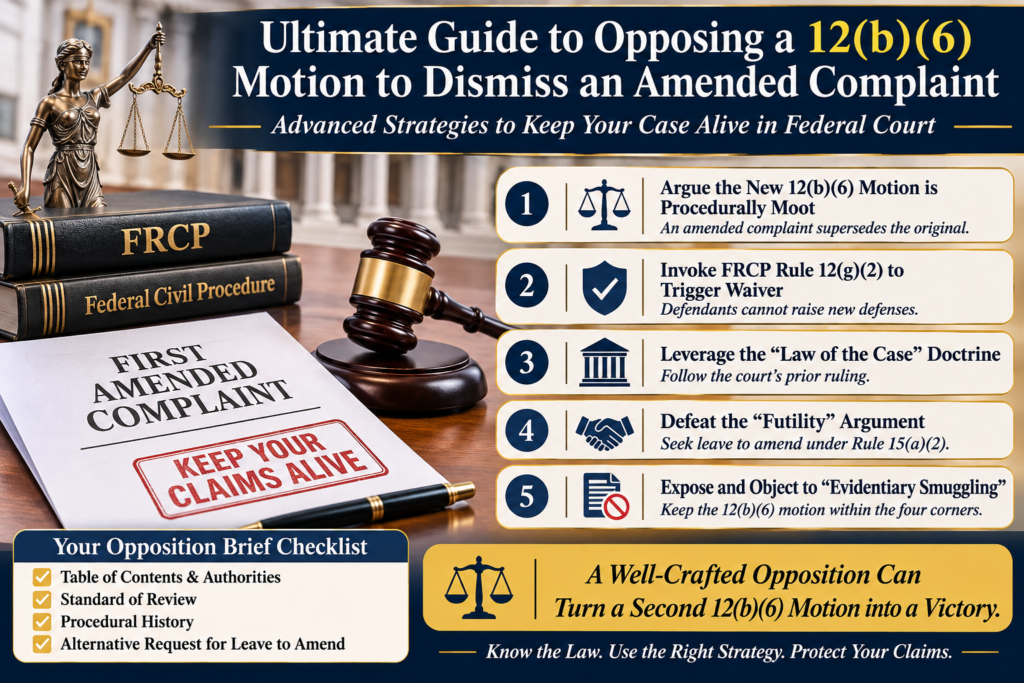
To beat a second 12(b)(6) Motion to dismiss attack, you must move beyond basic pleading standards like the “four corners rule” or the Twombly/Iqbal plausibility framework. This article delivers advanced, tactical litigation strategies to write an unshakeable opposition brief against a motion to dismiss your amended complaint.
1. Argue That the New 12(b)(6) Motion to dismiss is Procedurally Moot
A common mistake self-represented litigants make is responding to defense arguments targeting old, obsolete language. If a defendant files a motion to dismiss your original complaint, and you properly file an amended complaint, the timeline resets entirely.
The Law
An amended complaint completely supersedes and replaces the original complaint. Legally, the prior pleading ceases to exist.
Litigation Strategy
If the defendant attempts to recycle their original motion, or fails to file a brand-new motion meticulously customized to the text inside your FAC, object immediately. Cite established circuit precedent confirming that a motion to dismiss targeting a defunct complaint is procedurally moot and must be denied out of hand.
2. Invoke FRCP Rule 12(g)(2) to Trigger Waiver of Omitted Defenses
Defense attorneys frequently use an amended complaint as an excuse to conduct a “trial run” of secondary legal theories they forgot to include in their original 12(b)(6) motion to dismiss. This piecemeal litigation strategy violates federal civil procedure.
The Law
Under FRCP Rule 12(g)(2) (the omnibus motion rule), a party making a motion under Rule 12 must not make another motion raising a defense or objection that was available to them but omitted from their prior motion.
Litigation Strategy
Scrutinize the defendant’s new motion line-by-line. Did they suddenly introduce a statutory technicality, a venue objection, or an affirmative defense that was fully available when you filed your original complaint? Argue that the defense waived their right to raise these new issues. They had their bite at the apple; they cannot drag out litigation by holding back available defenses.
3. Leverage the “Law of the Case” Doctrine
If your complaint was amended because the judge dismissed your original complaint with leave to amend, the court’s prior dismissal order serves as a binding litigation roadmap.
The Law
The Law of the Case doctrine dictates that when a court decides upon a rule of law or an issue at one stage of a case, that decision governs the same issues in subsequent stages of the same litigation.
Litigation Strategy
If you modified your FAC to satisfy the exact criteria, factual gaps, or elements the judge highlighted in the prior dismissal order, state this clearly in your brief. Argue that because you followed the court’s exact blueprint, the legal sufficiency of those specific claims constitutes the Law of the Case. The defense cannot re-litigate issues or demand higher pleading burdens than what the court already deemed acceptable.
4. Defeat the “Futility” Argument and Secure Leave to Amend
When a defendant moves to dismiss an amended complaint, their closing argument is almost always a demand for a dismissal with prejudice, claiming that “further amendment would be futile.” If the judge agrees, your lawsuit is permanently extinguished.
The Law
FRCP Rule 15(a)(2) mandates that courts should “freely give leave [to amend] when justice so requires.” The U.S. Supreme Court has repeatedly affirmed that public policy strongly favors deciding legal claims on their true merits rather than technical pleading traps.
Litigation Strategy
Even if you believe your amended complaint is flawless, always embed a strategic alternative request at the conclusion of your opposition brief. Explicitly state:
“In the alternative, if this Court finds any portion of the First Amended Complaint deficient, Plaintiff respectfully requests leave to amend pursuant to Rule 15(a).”
To dismantle the defendant’s “futility” label, use your brief to explain exactly what additional facts, context, or evidentiary details you could add in a Second Amended Complaint to cure any minor defects. Dismissal with prejudice is a drastic, disfavored remedy; show the judge that your claims can be easily saved.
5. Expose and Object to “Evidentiary Smuggling”
Frustrated by the new factual details added to your amended complaint, defense attorneys often attempt to sneak outside evidence—such as unauthenticated contracts, internal emails, or self-serving affidavits—into their second motion to dismiss to prove your new allegations wrong.
The Law
A 12(b)(6) motion evaluates legal sufficiency, not factual accuracy. Under FRCP Rule 12(d), if a party introduces matters outside the pleadings on a 12(b)(6) motion to dismiss , the court must either exclude those materials or convert the entire motion into a full-scale Rule 56 Motion for Summary Judgment, which opens the floodgates to discovery.
Litigation Strategy
If the defense attaches outside exhibits, aggressively object. Remind the court of the strict boundaries of the “Four Corners” rule. If the defendant claims the court can take Judicial Notice of a public or corporate document, counter by arguing that while a court may take notice that a public record exists, it is legally prohibited from taking judicial notice of the truth of the disputed facts asserted inside that document.
Essential Opposition Brief Checklist
To maximize your chances of defeating an amended motion to dismiss, ensure your opposition contains these structural components:
- Table of Contents & Authorities: Ensure all cited circuit court rulings and federal rules are accurately mapped.
- Standard of Review Section: Emphasize that the court must accept all well-pleaded facts in your FAC as true and draw all reasonable inferences in your favor.
- Procedural History: Clearly demonstrate how you cured the specific defects from any prior pleadings or complied with the court’s earlier instructions.
- Alternative Request for Leave: Always protect your case against a dismissal with prejudice by preserving your Rule 15 rights.
To help fine-tune these advanced arguments for your specific case, let me know:
- What specific cause of action (e.g., breach of contract, fraud, civil rights, employment discrimination) is the defendant trying to dismiss?
- Did the defense attach any outside documents or exhibits to their new motion?
- Are they raising any completely new legal arguments that they didn’t mention in their first motion?