
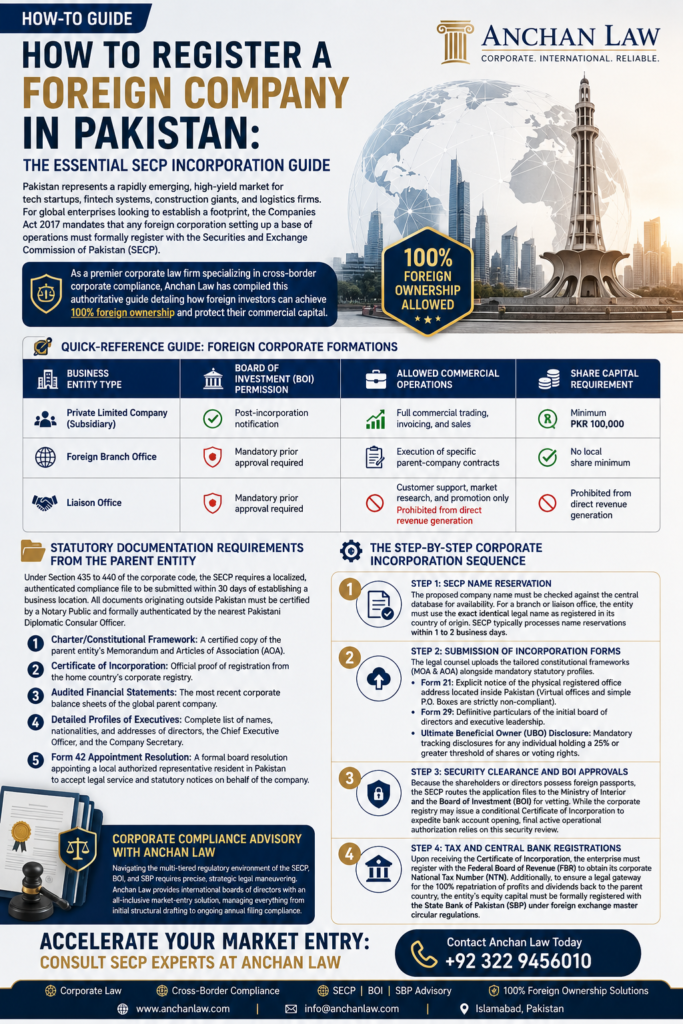
Pakistan represents a rapidly emerging, high-yield market for tech startups, fin-tech systems, construction giants, and logistics firms. For global enterprises looking to establish a footprint, the Companies Act 2017 mandates that any foreign corporation to Register a Foreign Company in Pakistan a base of operations must formally register with the Securities and Exchange Commission of Pakistan (SECP).
As a premier corporate law firm specializing in cross-border corporate compliance, Anchan Law has compiled this authoritative guide detailing how foreign investors can achieve 100% foreign ownership and protect their commercial capital and How to Register a Foreign Company in Pakistan.
📊 Quick-Reference Guide: Foreign Corporate Formations
Foreign entities can enter the Pakistani market through three primary legal corporate structures:
| Business Entity Type | Board of Investment (BOI) Permission | Allowed Commercial Operations | Share Capital Requirement |
| Private Limited Company (Subsidiary) | Post-incorporation notification | Full commercial trading, invoicing, and sales | Minimum PKR 100,000 |
| Foreign Branch Office | Mandatory prior approval required | Execution of specific parent-company contracts | No local share minimum |
| Liaison Office | Mandatory prior approval required | Customer support, market research, and promotion only | Prohibited from direct revenue generation |
Statutory Documentation Requirements from the Parent Entity.
Under Section 435 to 440 of the corporate code, the SECP requires a localized, authenticated compliance file to be submitted within 30 days of establishing a business location. All documents originating outside Pakistan must be certified by a Notary Public and formally authenticated by the nearest Pakistani Diplomatic Consular Officer.
The standard compliance file must include:
- Charter/Constitutional Framework: A certified copy of the parent entity’s Memorandum and Articles of Association (AOA).
- Certificate of Incorporation: Official proof of registration from the home country’s corporate registry.
- Audited Financial Statements: The most recent corporate balance sheets of the global parent company.
- Detailed Profiles of Executives: Complete list of names, nationalities, and addresses of directors, the Chief Executive Officer, and the Company Secretary.
- Form 42 Appointment Resolution: A formal board resolution appointing a local authorized representative resident in Pakistan to accept legal service and statutory notices on behalf of the company.
🏗️ The Step-by-Step Corporate Incorporation Sequence
Setting up your corporate entity through the SECP eServices Portal follows a strict, invariant four-step sequence:
1️⃣ Step 1: SECP Name Reservation
The proposed company name must be checked against the central database for availability. For a branch or liaison office, the entity must use the exact identical legal name as registered in its country of origin. SECP typically processes name reservations within 1 to 2 business days.
2️⃣ Step 2: Submission of Incorporation Forms
The legal counsel uploads the tailored constitutional frameworks (MOA & AOA) alongside mandatory statutory profiles:
- Form 21: Explicit notice of the physical registered office address located inside Pakistan (Virtual offices and simple P.O. Boxes are strictly non-compliant).
- Form 29: Definitive particulars of the initial board of directors and executive leadership.
- Ultimate Beneficial Owner (UBO) Disclosure: Mandatory tracking disclosures for any individual holding a 25% or greater threshold of shares or voting rights.
3️⃣ Step 3: Security Clearance and BOI Approvals
Because the shareholders or directors possess foreign passports, the SECP routes the application files to the Ministry of Interior and the Board of Investment (BOI) for vetting. While the corporate registry may issue a conditional Certificate of Incorporation to expedite bank account opening, final active operational authorization relies on this security review.
4️⃣ Step 4: Tax and Central Bank Registrations
Upon receiving the Certificate of Incorporation, the enterprise must register with the Federal Board of Revenue (FBR) to obtain its corporate National Tax Number (NTN). Additionally, to ensure a legal gateway for the 100% repatriation of profits and dividends back to the parent country, the entity’s equity capital must be formally registered with the State Bank of Pakistan (SBP) under foreign exchange master circular regulations.
💼 Corporate Compliance Advisory with Anchan Law
Navigating the multi-tiered regulatory environment of the SECP, BOI, and SBP requires precise, strategic legal maneuvering. Anchan Law provides international boards of directors with an all-inclusive market-entry solution, managing everything from initial structural drafting to ongoing annual filing compliance.
🏢 Accelerate Your Market Entry: Consult SECP Experts at Anchan Law