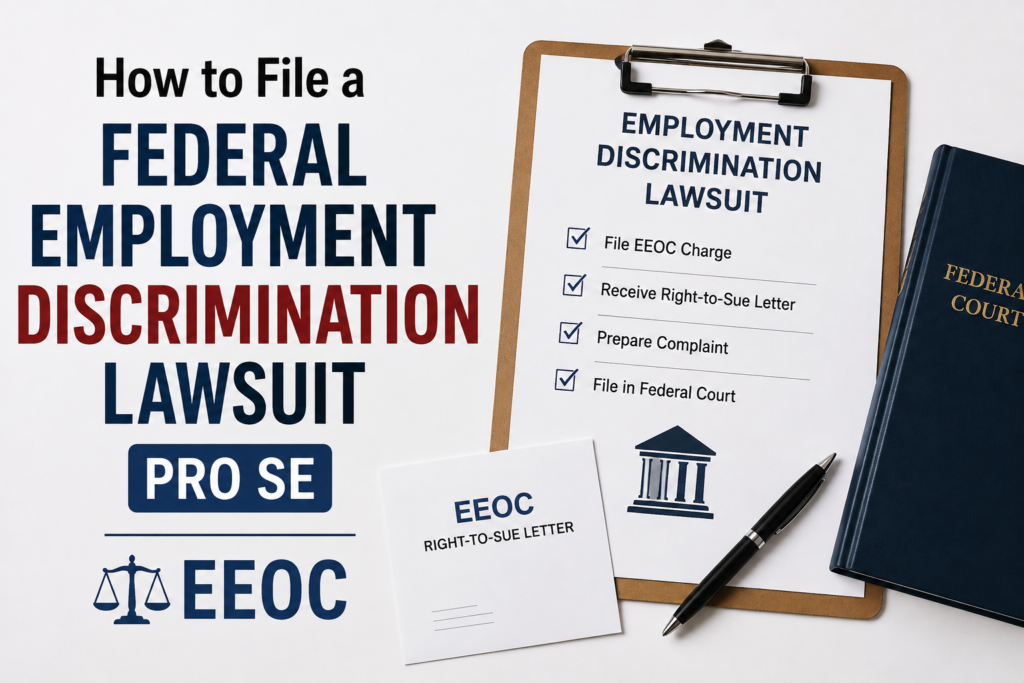
EEOC Right-to-Sue Letter: How to File a Federal Employment Discrimination Lawsuit Pro Se Within the 90-Day Window . Receiving a Notice of Right to Sue from the Equal Employment Opportunity Commission (EEOC) is a critical turning point in your fight against workplace injustice. Whether you faced wrongful termination, sexual harassment, or systematic bias, this letter means the administrative phase of your case is over.
Now, you have the legal right to take your employer to court. However, the clock is ticking.You face a strict, non-negotiable 90-day deadline to draft and file a formal civil complaint in federal court. If you miss this window by even a single day, you permanently lose your right to sue your employer under federal law. Here is how to navigate this high-stakes process as a self-represented (pro se) litigant.
What Does an EEOC Right-to-Sue Letter Actually Mean?A common misunderstanding among pro se litigants is that a Right-to-Sue letter means the EEOC found your employer guilty. In reality, it simply means the agency has finished its administrative review and closed its file.
The EEOC rarely files lawsuits on behalf of individuals. Instead, they issue this passport to federal court, giving you the green light to sue under major federal statutes, including:Title VII of the Civil Rights Act of 1964 (Discrimination based on race, color, religion, sex, or national origin)The Americans with Disabilities Act (ADA)
The Age Discrimination in Employment Act (ADEA)The letter does not mean your case is weak or strong—it simply means the burden of proof has shifted entirely to you.The Strict 90-Day Deadline: No ExceptionsThe day you receive the EEOC letter (either via mail or through the online portal), your 90-day countdown begins.Federal courts strictly enforce this timeline. Judges will not accept excuses like “I was looking for a lawyer,” “I didn’t understand the rules,” or “I was sick.” If your complaint is not stamped by the court clerk on or before Day 90, the defense will file a motion to dismiss, and the judge will throw your case out permanently.
Step-by-Step Guide to Filing Your Federal Employment Discrimination ComplaintFiling a lawsuit against an employer—especially a large corporation with a team of defense lawyers—requires a highly technical, structured document.
You cannot simply attach your EEOC charge and tell your story. You must draft a formal civil complaint
1. Choose the Correct Federal District CourtYou must file your lawsuit in the specific United States District Court that has jurisdiction over your case. This is usually the federal court district where the discrimination took place, or where the employer’s corporate headquarters or physical facility is located.
2. Format on Standard Pleading PaperYour complaint must be typed using standard legal formatting (such as 28-line pleading paper) or the specific pro se templates required by your local federal court. The caption must clearly list you as the Plaintiff and your employer’s legal corporate name as the Defendant.
3. Meet the Federal “Plausibility” Pleading StandardUnder United States Supreme Court precedents (Twombly and Iqbal), your text must move past generic emotional complaints.
You must state explicit facts that make your claim plausible.What to avoid (Conclusory):
“My boss fired me because he is racist.”What to write (Plausible Fact): “On November 12, 2025, Regional Manager John Doe explicitly stated [insert quote] during my performance review. Two weeks later, on November 26, 2025, I was terminated, while a similarly situated employee outside my protected class with lower sales metrics was retained.
- Explicitly Plead the Legal Elements of DiscriminationTo survive an initial motion to dismiss, your complaint must address every mandatory building block of an employment claim:Protected Status: State your protected class (e.g., race, age, disability, gender).Qualifications: State that you were meeting your employer’s legitimate job expectations.Adverse Action: Detail the negative action taken against you (e.g., demotion, suspension, wrongful termination).Causal Connection: Provide specific dates, timelines, and facts connecting your protected status or your HR complaints (retaliation) directly to the adverse action.Avoid the Defense Traps: Secure Professional Drafting SupportThe days following your receipt of an EEOC Right-to-Sue letter are filled with pressure. Corporate defense law firms look for pro se litigants who file rushed, unorganized complaints so they can immediately get them dismissed before the case ever reaches the discovery or trial phases.
.At Anchan Law, we specialize in providing court-ready Pro Se Litigant Support Services. We will analyze your EEOC file, extract your critical timeline facts, and draft a professionally structured, highly technical Federal Civil Employment Complaint designed to beat defense motions and protect your day in court.Don’t let the 90-day clock run out on your justice. Contact Anchan Law Today to have your Right-to-Sue letter reviewed and your federal complaint drafted by professional legal writing experts.